Step into history as you explore Concord’s many remarkable sites. From Revolutionary War
landmarks to literary treasures, there’s something for everyone to discover. Here is a quick reference list
to help you plan your visit. Be sure to check the website before heading out, as some sites may be
closed on holidays or for private events. Enjoy your journey through Concord’s rich past!
A well-known 19th-century nurseryman and fruit breeder, John B. Moore cultivated a fine apple orchard of approximately forty trees that he put up for sale in 1857. The orchard captured the heart of Amos Bronson Alcott, who considered the apple the most perfect of fruits.
So taken was he with the property’s six apple varieties that he
named his new home Orchard House.
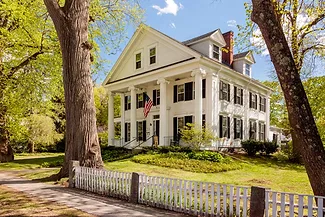
The Timothy Wheeler House, a Greek Revival home with a distinctive columned portico and gabled roof, has housed the Concord Home for the Aged since 1887. It was named for Timothy Wheeler, who owned the site and the land across the street where he operated a grist mill.
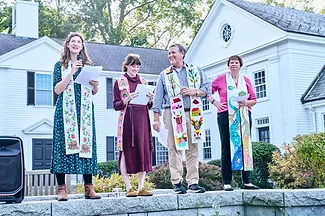
For the last fifteen years, The Robbins House has proudly told the stories of Black Concord through the lens of the Robbins and Garrison families. Originally located on an isolated farm overlooking the Great Meadows along the Concord River, the house is one of the only known historic sites commemorating the legacy of a previously enslaved Revolutionary War veteran named Caesar Robbins.
Step into history as you explore Concord’s many remarkable sites. From Revolutionary War landmarks to literary treasures, there’s something for everyone to discover. Here is a quick reference list to help you plan your visit. Be sure to check the website before heading out, as some sites may be closed on holidays or for private events. Enjoy your journey through Concord’s rich past!
In colonial America, taverns were commonplace throughout Freedom’s Way National Heritage Area. But these early American taprooms were much more than just watering holes. They served an important purpose in the community as a place for townsfolk to gather and plan. This proved especially important in the years leading up to the Revolution. Taverns became Patriot refuges, where decisions were made about separation from the Crown and what a more democratic form of government would look like. As British-colonial relations finally boiled over, taverns became meeting spots for Patriot militias to assemble and prepare for battle.
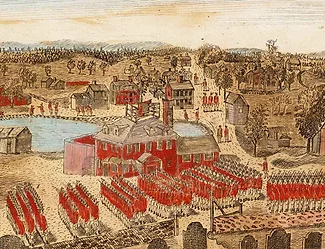
During the colonial period, taverns served as important community centers, where people could learn current events, hear from travelers, and discuss politics and the latest gossip. The Wright Tavern, built by Captain Ephraim Jones in 1747, was ideally located between the Meeting House (now the First Parish in Concord) and the training grounds for the militia.
This year, the Trinitarian Congregational Church (TriCon) on Walden Street is celebrating its 200th anniversary. However, from the early days of Concord’s founding in 1635, there was only one meeting house, and that was First Church in the center of town. In 1778, Reverend Ezra Ripley assumed
the pastorate, a position he would
hold for 63 years. By 1825, First Parish, like many Congregational churches
in Massachusetts, had changed, adopting a Unitarian theology. But
not all parishioners were happy with
“Dr. Ripley’s church” or his unorthodox preaching. In March 1826, nine dissenters, joined by seven townspeople, left First Parish to form their own “religious conference.”
Concord Center takes justifiable pride in its history, but today great things are happening in West Concord. Innovation and self-reliance are nothing new on the west side of Route 2; they’ve defined the community for centuries.
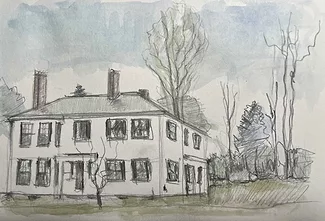
Simplicity weaves a rich tapestry of beauty and a sense of quietness in the landscapes surrounding Concord. Among them is Emerson’s humble potato garden, where a solitary tree is bordered by a weathered fence. This sketch evokes a meditative calm, capturing moments of stillness that remind us of the profound experiences that often stem from the simplest things, drawing attention to the elegance found in the everyday. And as Ralph Waldo Emerson poignantly expressed, “The invariable mark of wisdom is to see the miraculous in the common.” It might be in the gentle rustle of leaves, the serene play of light across a quiet room, or the unassuming bloom of a wildflower that we find a deeper connection to the world around us.
-(1).webp?height=325&t=1782928944&width=325 "Robbins-House-15th-Anniversary-(7)-(1).jpg")