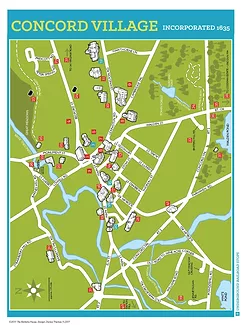
The Robbins House – Concord’s African American History started with a map. Local resident Maria Madison, PhD, who would go on to co-found the the nonprofit organization, The Robbins House Inc., noticed streets in Concord named after early Black residents such as Bristers Hill (33), Peter Spring (27), and Jennie Dugan (39) Roads. Who were these people? Dr. Madison and a few other Concord METCO (Metropolitan Council for Educational Opportunity) family friends created a map of Concord’s African American history so that students of color from Boston and Concord could see their own history reflected in this storied town. When the Robbins House, a residence which occupied two locations (23 & 24) from 1823-2007, was threatened with demolition, The Robbins House nonprofit was formed to save, move, and restore the building as a center for telling Concord’s lesser-known Black history.
A trip to Concord, Massachusetts is a must for any lover of American history. The town boasts a dazzling literary history and is also home to the celebrated “shot heard ‘round the world,” aka, the first battle in the American War for Independence. Additionally, there are at least ten thousand years of Native American history to explore, and a remarkably complex African American history beginning in the 1600s.
With several centuries’ worth of attractions in a small geographical area, there is more than enough to keep people of all ages bewitched and busy for days. But, the vast substance of Concord’s history can also be its greatest challenge, especially for visitors.
On April 19, 1775, the long-simmering uneasiness between the American colonies and the British Crown broke out into open warfare with the Battles of Lexington and Concord. A year later, rebellion turned into revolution and, in 1783, after eight years of war, the United States of America gained its independence from Great Britain.
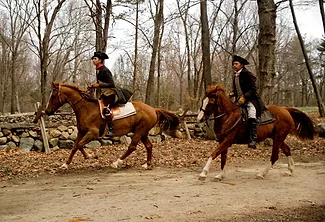
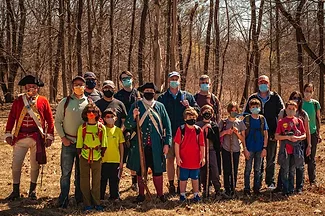
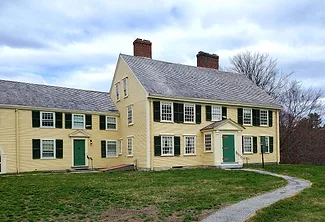
Today, visitors to Minute Man National Historical Park can experience firsthand where the American Revolution began. The Park passes through three towns; from the Battle Green in Lexington, past the Hartwell Tavern and Bloody Angle in Lincoln, and westward to the Old North Bridge in Concord. Parts of the five-mile-long Battle Road Trail literally follow in the footsteps of the Colonial militia and British Redcoats. Along the way, there can be seen many buildings, called “Witness Houses” by the National Park. These were the homes and farms of the people who lived here in the 18th century, and these houses bear mute testimony to the violence, chaos, and bloodshed of April 19, 1775.
Here are four of the eleven historic buildings you’ll see on the Battle Road Trail, highlighting the lives of the people who experienced the first day of the American Revolution.
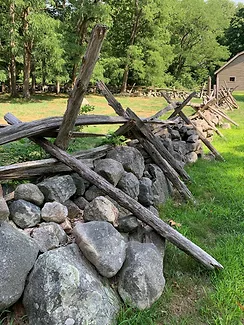
When thinking of famous walls in history, what are the first that come to mind? The Great Wall of China, Hadrian’s Wall, and the Berlin Wall are all common answers. What about the stone walls at Minute Man National Historical Park? Those simple barriers might not be the first wall you think of, but their role in history is just as important as the more well-known walls.
Sleepy Hollow Cemetery, which is recognized on the National Register of Historic Places, is the final resting place of many well-known luminaries like Louisa May Alcott, Nathaniel Hawthorne, Henry David Thoreau, and others whose lives have been documented in numerous ways.
But there is much more to Sleepy Hollow Cemetery, including the burial sites of some fascinating people who may not be as familiar. Their graves can be located on the framed maps at the Cemetery entrances.
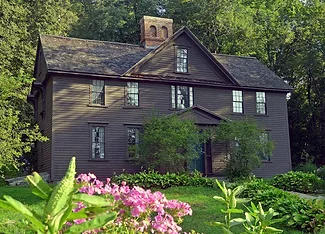
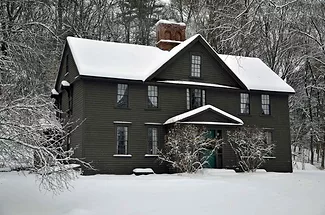
“Christmas won’t be Christmas without any presents, grumbled Jo . . .” The irony — the beautiful irony — of Louisa May Alcott’s opening words in Little Women is striking, as the ultimate message of the book is quite the opposite of its iconic opening line. Readers of Little Women simply begin a journey that leads to a boldly empowering expansion of the heart. We follow along with the March sisters as they learn to care for others, even while struggling with their own desires and disappointments, and we identify with their experiences. Whether enacting a play for an audience in their parlor, or preparing to give their Christmas breakfast feast to a needy family, our mind’s eye envisions the girls’ widening realization that caring for something other than self and sharing what gifts they possess are far more fulfilling than receiving presents.
In October 2019, I designed a literary pilgrimage that would take me to the Thoreau Farm in Concord, Massachusetts. I would be a writer in retreat in the second-story bedroom where Thoreau was born, and a few days later I would be a student participating in a writing workshop held by The Write Connection and taught by Heidi Jon Schmidt.
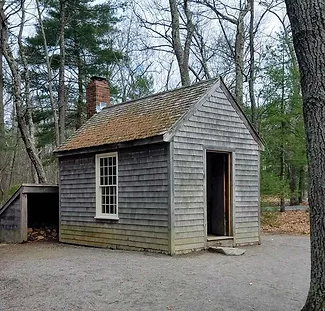
On September 6, 1847, Henry Thoreau left his small house at Walden Pond and moved back into the town of Concord. Having lived at Waldon Pond for over two years, he was, he would write, “a sojourner in civilized life again.”
Concord is a town steeped in history. From the American Revolution that began here in 1775, to the beginnings of transcendentalism in the 1830’s. From ground-breaking social justice activists who opposed slavery and supported women’s rights, to authors whose works are pillars of the American literary canon. While we could happily spend a lifetime studying the myriad aspects of Concord’s history and its vibrant contemporary society, here are just a few of our favorite places to visit.
The Battle at the North Bridge on April 19, 1775, was well documented, but the running battle of the Minutemen and militia companies chasing the Regular Army out of Concord back to Charlestown along what we now call Battle Road is lesser-known. Records are incomplete and make the first five miles of the retreat impossible to reconstruct accurately. Nevertheless, the National Park Service has hunted down slender clues to provide a more complete history to the forgotten families who experienced fighting on their front lawns. Minute Man National Historical Park Ranger Jim Hollister was able to share some stories about families that lived on the Battle Road.

.webp?height=325&t=1727468883&width=325 "Thoreau-Farm-Birth-House--(1).jpg")