For the last fifteen years, The Robbins House has proudly told the stories of Black Concord through the lens of the Robbins and Garrison families. Originally located on an isolated farm overlooking the Great Meadows along the Concord River, the house is one of the only known historic sites commemorating the legacy of a previously enslaved Revolutionary War veteran named Caesar Robbins.
Last fall, the Town of Concord and Concord250 were proud to be among the 37 selected recipients of a Massachusetts250 Grant provided by the Healey-Driscoll Administration and the Massachusetts Office of Travel and Tourism. The grant funded the project “A Fight for Freedom: Honoring Patriots of Color.”
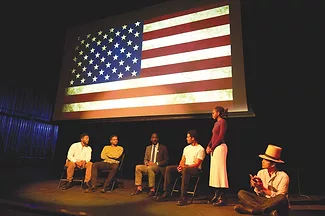
For many months, scholars, interpreters, and artists collaborated to create this signature event. The program launched in March at The Umbrella Center for the Arts with a two-hour live event dedicated to uncovering and honoring the often-overlooked contributions of Black and Indigenous Patriots during the American Revolution and the ongoing struggle for freedom and equality over the past 250 years.
On the morning of April 19, 1775, 71-year-old Martha Moulton witnessed a terrifying scene: hundreds of red-coated British Regulars marching into the town of Concord. These men were on orders from British General Thomas Gage to seize and destroy contraband military supplies stockpiled by the Provincial Congress. The ensuing conflict between the Regulars and Provincials sparked the American Revolution.
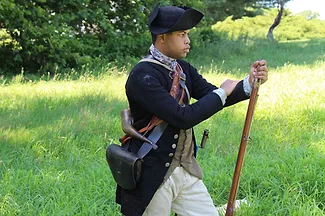
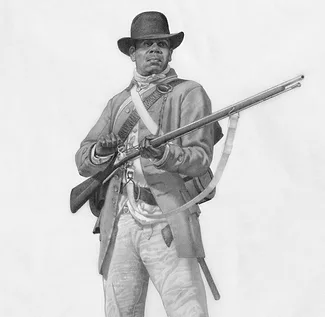
On April 19, 1775, an estimated twenty to forty colonists of African or Native American descent fought in the first battle of the American Revolution. On that historic day, those men, often termed “Patriots of Color,” joined approximately 4,000 other men fighting British Regular soldiers along the “Battle Road” from Concord to Boston. Over the last 250 years, racism and historical bias have effectively ignored or trivialized the contributions of those men and many other people of color in the historic struggle that produced the United States. To understand who the Patriots of Color were, how they contributed to the American Revolution, and why they chose to do so, we must examine their social context.
On April 19, 1775, an estimated twenty to forty colonists of African or Native American descent fought in the first battle of the American Revolution. On that historic day, those men, often termed “Patriots of Color,” joined approximately 4,000 other men fighting British Regular soldiers along the “Battle Road” from Concord to Boston.
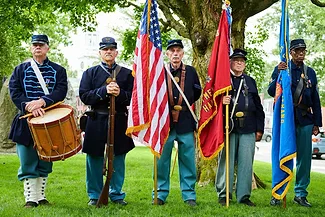
This year, for the first time in 160 years, the town paused to honor and celebrate the story of its Black native son, George Washington Dugan. Dubbed “GLORY for George,” this celebration engaged visitors and locals alike to honor the legacy of George Washington Dugan on the 160th anniversary of his heroic sacrifice as a member of the 54th Massachusetts, the first all-Black regiment of the Civil War.
How could an enslaved man or woman ever find a path out of bondage? The Emancipation Proclamation, issued in 1862 by President Abraham Lincoln and formally signed and put into effect on January 1, 1863, is well-known throughout the country. Much less well-known are the thousands of emancipations that occurred in New England long prior to 1862, many happening one at a time.
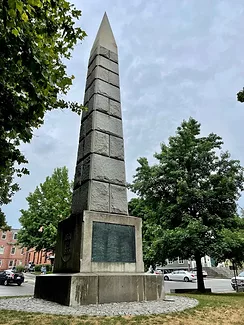
The focal point of Concord’s historic Monument Square is the Civil War Monument. A bronze plaque on the obelisk honors the names of 48 local men who lost their lives in the Civil War; however, 49 Concord men paid the ultimate price. Private George Washington Dugan’s name is missing.
January 1, 1863. As the Civil War entered its third bloody year, President Abraham Lincoln signed his Emancipation Proclamation. With a stroke of his pen, Lincoln ensured that the war now took on a bigger objective. It was not just a fight to save the Union; the lives — and freedom — of nearly four million enslaved African Americans now depended on the success of the Federal armies.
With the Emancipation Proclamation, nearly 200,000 Black men, many of whom had been slaves, now joined the Union Army to fight in a war that had already taken the lives of tens of thousands of white men. This sudden surge of manpower would help tip the balance to Union victory in 1865.
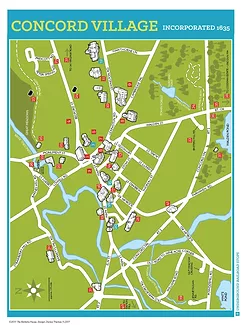
The Robbins House – Concord’s African American History started with a map. Local resident Maria Madison, PhD, who would go on to co-found the the nonprofit organization, The Robbins House Inc., noticed streets in Concord named after early Black residents such as Bristers Hill (33), Peter Spring (27), and Jennie Dugan (39) Roads. Who were these people? Dr. Madison and a few other Concord METCO (Metropolitan Council for Educational Opportunity) family friends created a map of Concord’s African American history so that students of color from Boston and Concord could see their own history reflected in this storied town. When the Robbins House, a residence which occupied two locations (23 & 24) from 1823-2007, was threatened with demolition, The Robbins House nonprofit was formed to save, move, and restore the building as a center for telling Concord’s lesser-known Black history.
-(1).webp?height=325&t=1782928944&width=325 "Robbins-House-15th-Anniversary-(7)-(1).jpg")