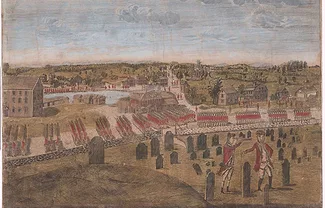
“Alerted by signal lanterns, express riders Paul Revere and William Dawes eluded British patrols and spurred their horses toward Lexington along separate routes to warn Hancock and Adams.”1
“When Revere and fellow patriot William Dawes saw two lights shine, they set off on horseback. Using two different routes out of Boston, they sounded the alert.”2
Busted:
Neither Paul Revere nor William Dawes received news of the Regulars’ advance by signal lanterns. In his classic “Paul Revere’s Ride,” published in 1861, Henry Wadsworth Longfellow exercised considerable poetic license with his legendary “One if by land, two if by sea” drama.
Colonial rebels in Concord did not wait until April 1775 to reject British rule. They did so in October of 1774, a full six months earlier—and a small tax on tea was the least of their complaints.
Earlier that year, as punishment for the Boston Tea Party, Parliament had passed the so-called Coercive Acts. Today, closing the Port of Boston gets all the press, but two different measures actually tipped the scales and led to revolution.
Colonial rebels in Concord did not wait until April 1775 to reject British rule. They did so in October of 1774, a full six months earlier—and a small tax on tea was the least of their complaints.
Earlier that year, as punishment for the Boston Tea Party, Parliament had passed the so-called Coercive Acts. Today, closing the Port of Boston gets all the press, but two different measures actually tipped the scales and led to revolution. The Massachusetts Government Act revoked the 1691 Provincial Charter, effectively disenfranchising the citizenry: no more town meetings, no more say in choosing local and provincial officials. The Administration of Justice Act allowed the Crown to transport accused citizens to Great Britain for trial. Before this, the colonial population was divided between so-called “Whigs” or “patriots,” who protested various acts of Parliament, and so-called “Tories” or “government men,” those more sympathetic to British law. But after these measures, only a handful of diehards dared argue that disenfranchisement was the way forward. Their constitution nullified and their right to a fair trial abrogated, people throughout Massachusetts, more united than ever before and possibly ever since, rose up as a body to say: “No way!”