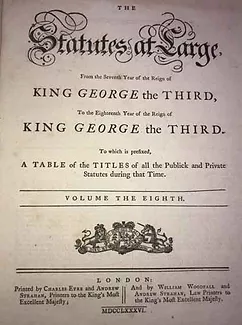
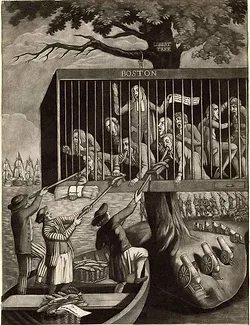
The Massachusetts Government Act of 1774 was a legislative measure enacted by the British Parliament in response to escalating colonial unrest, particularly following the Boston Tea Party. This act sought to tighten British control over the Massachusetts Bay Colony by significantly altering its governance structure and severely limiting the colonists’ civil liberties.
Before passage of the act, Massachusetts enjoyed a significant degree of self-governance, allowing colonists to exercise local autonomy and manage provincial affairs with minimal interference. However, following the Tea Party, British officials viewed this autonomy as a breeding ground for resistance to British economic and political policies and potential rebellion. Thus, the act aimed to curtail these self-governing privileges and signal expected obedience to royal authority.
Passed on March 31, 1774, the Boston Port Act closed Boston Harbor to most commerce, demanded reparations for the destroyed tea, and imposed a naval blockade on the town. This drastic measure crippled the town’s economy—a significant blow to a seaport heavily reliant on maritime trade. Businesses shuttered, unemployment soared, and the town faced economic ruin.
Parliament believed that the colonies would not support Boston and that it would only be a short time before Boston acquiesced and paid for the tea, reestablishing British authority in the colonies.1 Word of the act reached the colonies on May 11, setting off immediate anger and opposition. The May 16 edition of the Boston Evening Post warned, “AMERICANS … Tyranny without a covering now stares you all in the face. . . You must ALL unite to guard your Rights, or you will ALL be slaves!”2
The Boston Massacre unfolded on March 5, 1770, on King Street in Boston. While often depicted as a brutal act of British oppression, a closer look reveals the incident was the result of increasing friction between the colonists and the British authorities.
A series of economic acts passed by the British Parliament in the 1760s designed to generate revenue and curb England’s massive debt from the French and Indian War sowed the seeds of discontent in the Massachusetts colony. Colonists in America fiercely resisted these measures, viewing them as an infringement on their rights as British citizens. While many colonists adopted a policy of economic boycotts to reverse the laws, others, especially those in Boston, resorted to violence.
On February 26, 1775, a confrontation occurred in the port town of Salem, Massachusetts, today known as “The Salem Affair.” Although many historians gloss over this event, it nearly triggered the start of the American Revolution and accelerated Massachusetts’ wartime preparations.
Since 2000, many reenactors have asserted that haversacks were commonly worn by Massachusetts militia and minute companies when they fielded against British forces on April 19, 1775. The two most common arguments advanced have been that militia and minutemen were in possession of haversacks because they were previously issued to Massachusetts troops during the French and Indian War, or that the item was acquired on the eve of the American Revolution from a third-party source.
Historians have often overlooked a critical aspect of the Battles of Lexington and Concord; the psychological and physical impact on the civilian populace.
In 1774 when Parliament passed the Boston Port Act in an attempt to break the Massachusetts colonists of their resistance to crown policy, it also authorized English General and acting Massachusetts Governor Thomas Gage to undertake any military measures necessary to help bring the colony under control. In late winter and early spring of 1775, Gage received a series of dispatches from London ordering him to not only arrest the leaders of Massachusetts’ opposition party but to launch a major strike against the apparently growing provincial stockpiles of weapons and munitions located throughout eastern Massachusetts.
In 1774, a war between England and Massachusetts Bay Colony appeared inevitable. In preparation, Massachusetts militiamen relied upon muskets obtained from various sources: inheritance, the French and Indian War, the Siege of Louisbourg, and commercial markets.
The result was a variety of weapons of different caliber, origins, and values.