
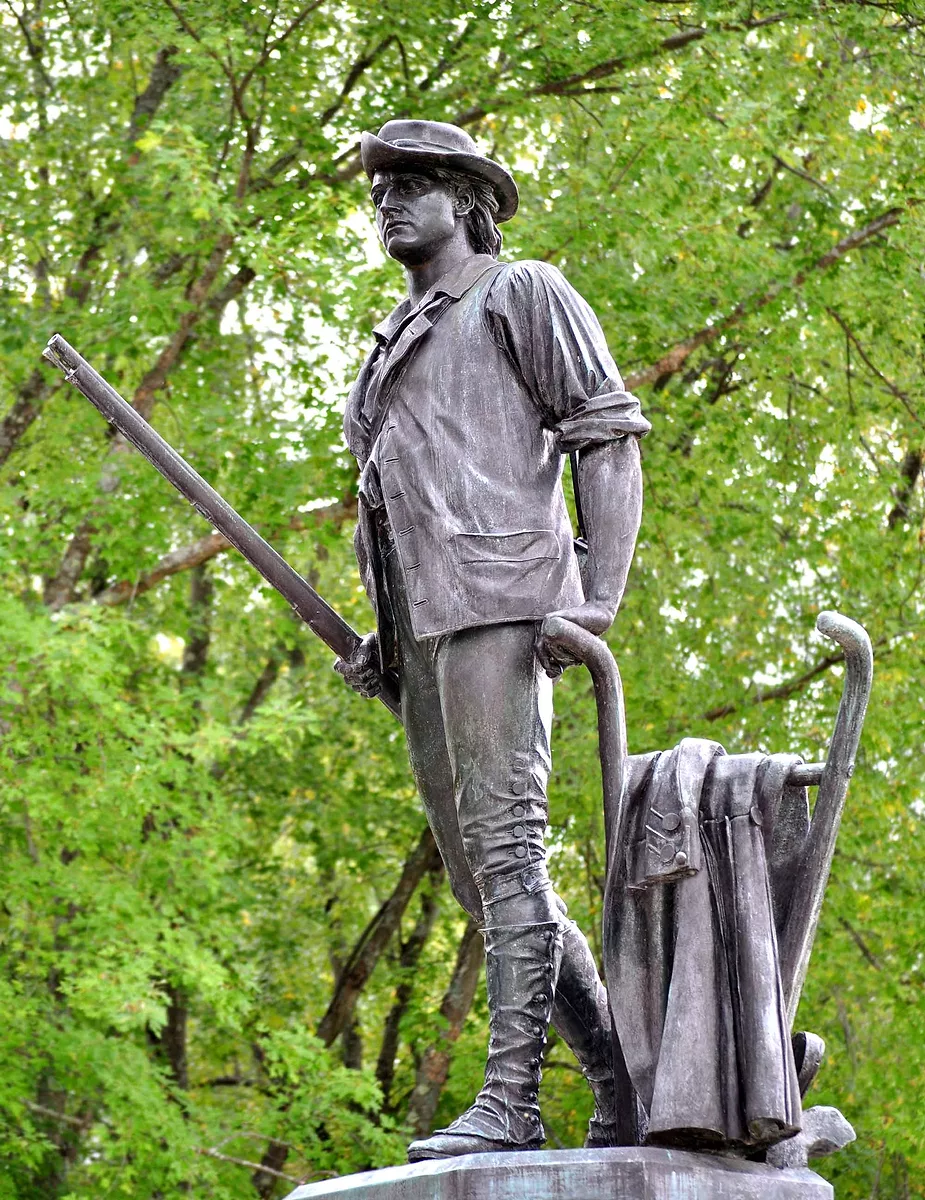
His eyes are bronze, formed in fire; and if you walk from Concord Center two blocks up Monument Street, you will find him staring at you from where he stands high atop a granite base, overlooking the North Bridge battle site and the straight gravel path from the bridge to the road. He is the Minute Man statue created by Concord sculptor Daniel Chester French, and was witness to part of the story you’re about to read.
This tale begins in 1856 in Exeter, New Hampshire, when consumption forever closed the eyes of 44-year-old Annie French. She left behind her husband, Henry, who was a lawyer and judge, and four young children, including her six-year-old son, Daniel. The widowed judge moved his family to the Boston area, remarried, and, in 1865, bought a house in Concord on Sudbury Road from which he could take the train to his law office in Boston.
When Daniel turned 17, he entered the 1867 freshman class at Massachusetts Institute of Technology (MIT) but soon flunked out and returned to Concord. Having observed Daniel’s artistic leanings, particularly his skill at carving with a knife, his family encouraged him to pursue a career in his passion.
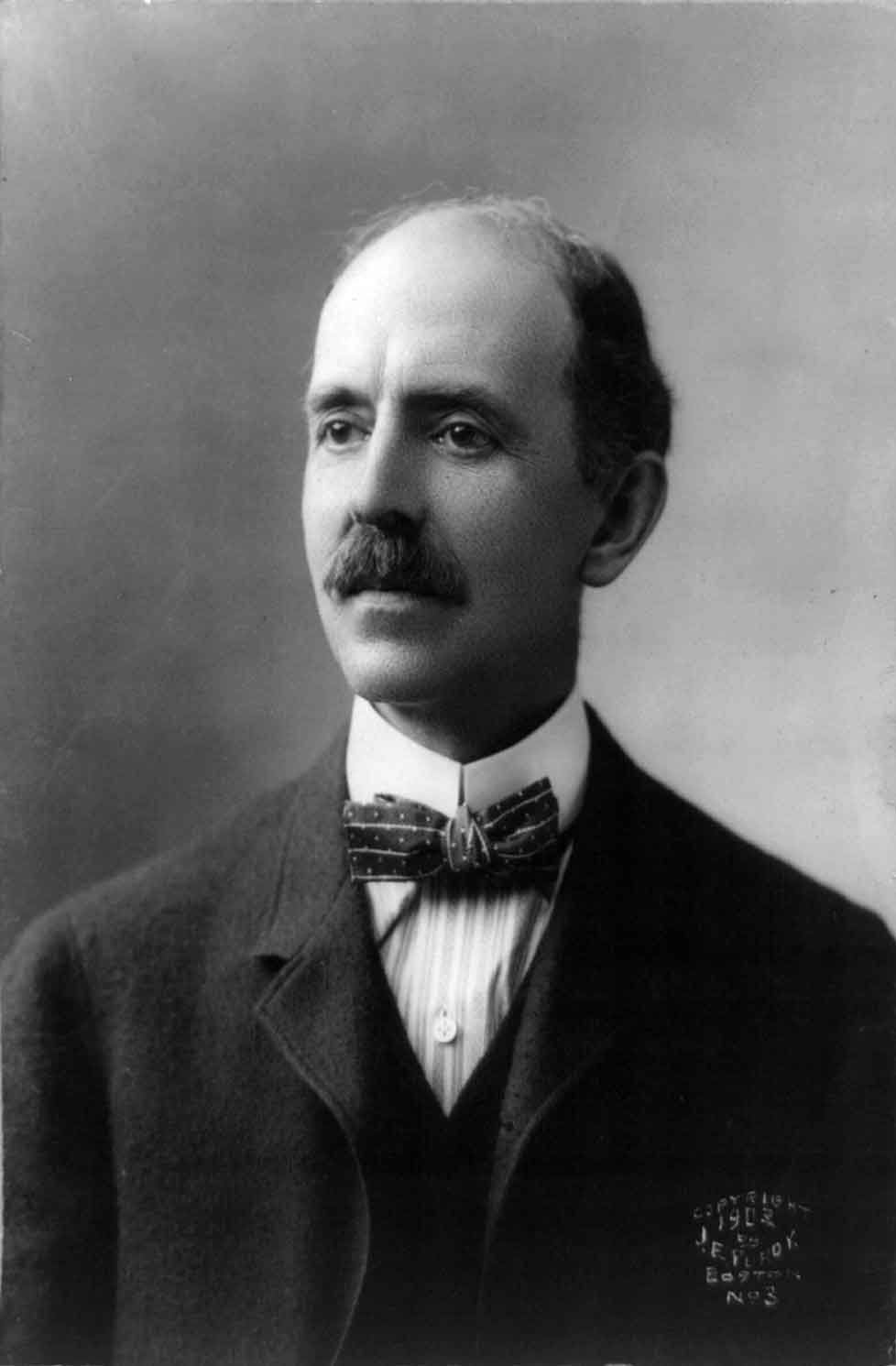
Daniel Chester French, 1902
| James E. Purdy, Public domain, via Wikimedia CommonsOn his usual commute into Boston, Daniel’s father, Henry, rode the train with their nearby Concord neighbor, May Alcott, who gave drawing lessons in Boston. As shared in Caroline Ticknor’s May Alcott: A Memoir, Judge French approached May and “discussed [Daniel’s] unusual ability and his skill [carving] with a jackknife… On learning of the young man’s gift, May Alcott promptly offered to lend him her modeling tools” and gave him his first lump of clay. Henry hired May to give Daniel art lessons. The lessons began in 1868, the same year May’s older sister, Louisa May Alcott, wrote and published Little Women. Years later, Daniel wrote the preface for May’s biography, crediting her with giving him his start in his career as a sculptor.
Daniel’s early works included busts of famed Concord residents, some of which can be seen in the Concord Free Public Library. In the 1870s, the town of Concord commissioned him to create a statue honoring the centennial of the April 19, 1775, Battle of Concord. Daniel crafted the seven-foot-tall Minute Man statue depicting a colonial farmer with his left hand on a plow and right hand holding a flintlock musket, representing the spirit of militia men who stood at the North Bridge on that fateful day. The statue was made of ten melted-down bronze Civil War cannons and unveiled during the centennial observations in April 1875.
Daniel’s career grew. His sculptures became icons in American history, including the seated Abraham Lincoln at the Lincoln Memorial in Washington, D.C. He died in 1931 and was buried in Concord’s Sleepy Hollow Cemetery on a hilltop opposite Authors Ridge. For the next twelve years, the grass weaved over his grave. Up the road, his Minute Man statue kept watch over the North Bridge and Monument Street.
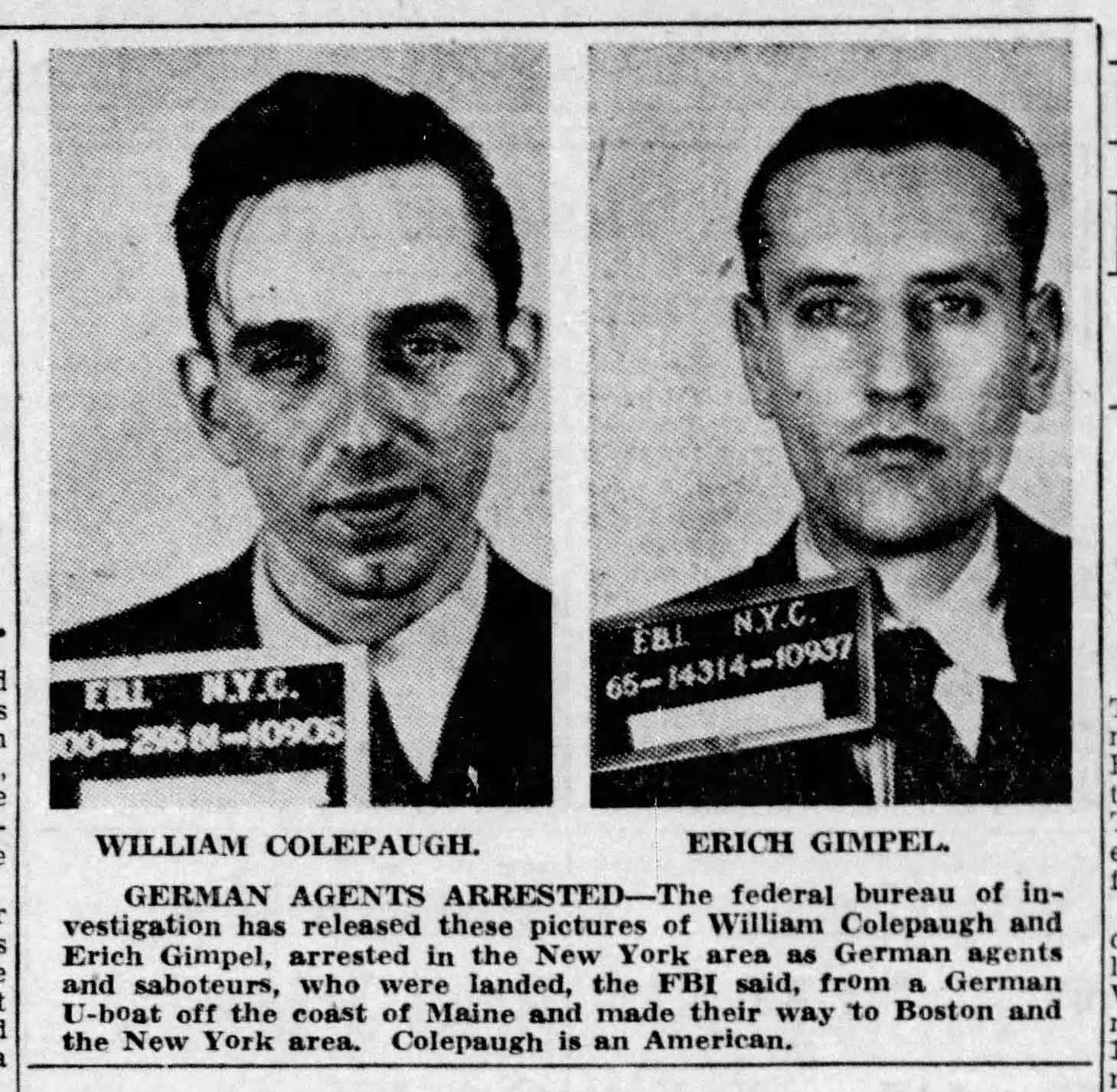 ©The Bay City Times, 1945
It was on Monument Street, in 1943, that the statue’s eyes saw a blue 1940s Oldsmobile sedan begin driving back and forth, leaving Concord in the late afternoons and returning in the early dawn. Behind the wheel was six-foot-tall, sandy-blonde-haired, 26-year-old William Curtis Colepaugh. Born in Connecticut in 1918 to an American father and German mother with Nazi-sympathizing views, Colepaugh first came to Massachusetts in 1938 to study engineering at MIT. Like Daniel Chester French, Colepaugh failed chemistry and physics and was forced to drop out. In fall 1939, as World War II exploded across the ocean, Colepaugh re-entered MIT, but failed again and was drafted into the Navy in 1940.
On his draft card, Colepaugh falsely described himself as “a student at MIT.” His military record is a story in itself, full of excuses and charges for failing to uphold his service; a tale that is well described in A True Story of an American Nazi Spy: William Curtis Colepaugh by Robert A. Miller.
In 1943, Colepaugh was discharged from the Navy and returned to Massachusetts. Seeking work that would grant him a deferral from further military service, he took a job at a poultry farm in Concord on Monument Street owned by Robert Woodman. Colepaugh worked there from March 1943 through January 1944, going into partnership with Woodman and raising 8,000 chickens. His time in Concord did not go unnoticed.
As described in Miller’s biography, Colepaugh lived at the farm and worked five and a half days a week. Yet he was always on the go; at night, driving past the Minute Man statue out of town, his car speeding back in the morning. Wartime gas rations were in effect, but rather than receiving the standard four to eight gallons of gas per week, Colepaugh applied for a higher gas ration, claiming he needed to drive his sick grandmother back and forth to Maine and to regularly travel to MIT, where he (falsely) said he worked. According to his biographer, Colepaugh conned his way into receiving enough gas to drive over 600 miles a month.
What he was doing is not clear, but his pro-Nazis views and his argumentative personality were noticed, and during his time in Concord, the eyes of the Minute Man statue were joined by those of the Massachusetts State Police, who began tracking Colepaugh.
When his service deferment ended in January 1944, Colepaugh joined the Merchant Marines and in February sailed aboard the SS Gripsholm to Lisbon, Portugal. There, he got off the ship, walked to the German Embassy, and defected to Germany as a spy. Colepaugh was partnered with German agent Erich Gimpel, and the two were directed to collect and transmit technical information on the war effort in the United States.
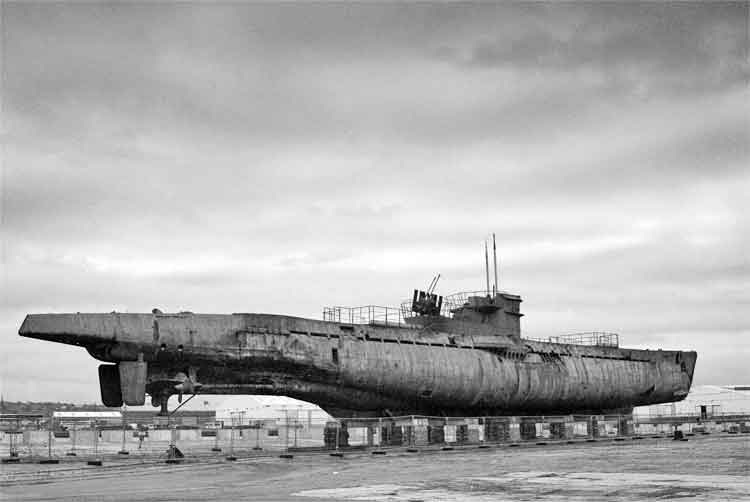
U-534, a type IXC/40 U-boat, the same type as U-1230
| Paul Adams, Public domain, via Wikimedia CommonsAs described in a United States Navy Investigative Report, in November 1944, Colepaugh and Gimpel boarded a German U-1230 submarine and crossed under the Atlantic to Frenchman’s Bay in Maine. On November 29, they arrived within a half mile of the shore. The U-1230 surfaced, a hatch opened, and a rubber boat was pushed out, followed by Colepaugh and Gimpel emerging into a bitterly cold snowstorm. As the submarine disappeared, the two men paddled to shore and began walking: destination New York City. The road from the beach was rarely used, and the sight of two hatless and lightly dressed men walking in the storm caught the eye of a local teenager and others in the small coastal fishing village. They reported the sighting to the FBI, but the report was not acted on until a month later, giving the two spies a head start. Perhaps it was the passing of Christmas Day that resculpted something in Colepaugh’s brain, for on December 26, 1944, he turned himself in to the FBI. He might have failed at MIT, but Colepaugh excelled at talking, providing the FBI with copious amounts of information on the Germans, the U-1230 operations, and his fellow spy Gimpel, who was subsequently arrested.
Colepaugh was tried by a military court and sentenced to death. However, three days before Colepaugh’s execution, President Roosevelt died and executions were put on hold. On June 28, 1945, the Concord Enterprise (Concord’s local newspaper) shared the news that, “William Curtis Colepaugh, the Nazi spy who once worked on a Concord farm, off Monument Street for a short time, before becoming an enemy agent, has received a commutation to life imprisonment from President Truman.” Colepaugh was paroled in 1960 and settled in Pennsylvania. Daniel Chester French had once written in a letter, “look for goodness, not evil,” and it was only a good side that Colepaugh showed to his new neighbors who knew nothing of his past. As described in Miller’s biography, Colepaugh became a member of the Rotary Club, started a youth leadership program, supported the Boy Scouts, and continued to tell everyone he graduated from MIT.
For a list of sources, email barrowbookstore@gmail.com.