I left the woods for as good a reason as I went there. Perhaps it seemed to me that I had several more lives to live and could not spare any more time for that one.
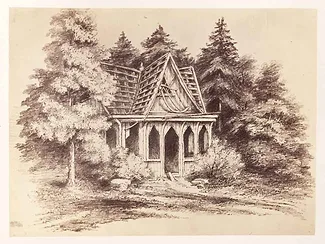
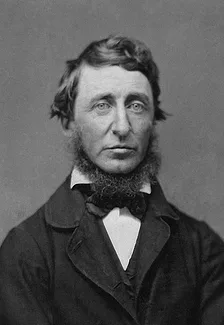
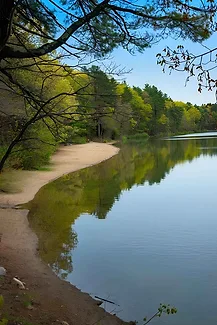
On September 6, 1847, Henry David Thoreau left his one-room house at Walden Pond and returned to Concord. Living at Walden for over two years had been a life-changing experience for the thirty-year-old Thoreau. Wanting to be a writer, he went to the pond to write, and while there he did exactly that. He produced two drafts of A Week on the Concord and Merrimack Rivers. He wrote one lecture about Thomas Carlyle and another about living at the pond called “A History of Myself.” He also penned an essay titled “Ktaadn” about going to Maine in the summer of 1846. And he wrote in his journal almost daily. But what would he do once he was back in Concord?
The abolitionists of the 19th century valued, revered, and lived by the words of the Declaration of Independence. The proclamation “We hold these truths to be self-evident, that all men are created equal, that they are endowed by their Creator with certain unalienable Rights, that among these are Life, Liberty and the pursuit of Happiness” affirmed that all individuals possess equal human dignity. The abolitionists lived in one era when our country was not living up to those words, and as we celebrate the 250th anniversary of the Declaration of Independence, like them, we find the promise of those words again in peril.
More than 160 years after his death, Henry David Thoreau remains one of Concord’s most influential voices. His writings on nature, conscience, simplicity, and social responsibility continue to inspire readers around the world. Helping to preserve and share that
legacy is the Thoreau Alliance, an organization dedicated to
ensuring that Thoreau’s ideas remain accessible, relevant, and
alive for future generations.
The Alliance brings together two organizations with deep roots
in Thoreau’s story: Thoreau Farm, his birthplace in Concord, and
the Thoreau Society, the oldest and largest organization dedicated to the study of a single American author. Together, they serve as a hub
for scholarship, education, public programming, and community engagement centered on one of America’s most influential thinkers.
Few American writers are as closely connected to a place as Henry David Thoreau (1817–1862). The landscapes of Concord and the surrounding towns—today part of Freedom’s Way National Heritage Area—shaped his ideas, inspired his writing, and helped define a philosophy that continues to influence readers around the world.
This itinerary follows Thoreau’s journey through the places that mattered most to him. From his birthplace at Thoreau Farm to his final resting place in Sleepy Hollow Cemetery, these homes, buildings, fields, forests, and waterways reveal the people and topography that helped form one of America’s most influential thinkers.
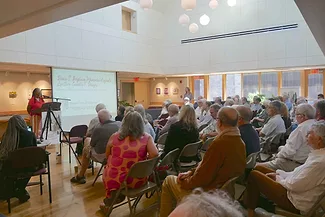
This year marks the 85th Annual Gathering of the Thoreau Society—the oldest and largest community devoted to an American author. Founded in 1941 by Walter Harding, the Society began with a simple invitation to a “Thoreau Birthday Mecca”: meet at Walden Pond, share lunch at Concord’s Colonial Inn, and talk about forming a group devoted to Henry David Thoreau.
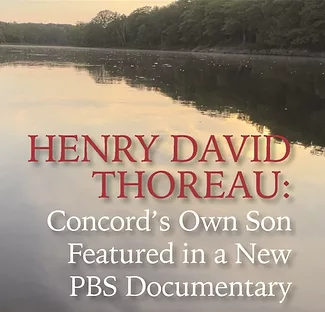
HENRY DAVID THOREAU, a new, three-part, three-hour film examines the life and work of Concord’s 19th-century writer in the context of antebellum New England and the larger United States, as well as through the universal themes he focused on in his writings: an individual’s relationship to the state, how to live an authentic life, our connection to nature, and the impact of race on American life. Ultimately, HENRY DAVID THOREAU presents a portrait of a man both rooted in his time and speaking far beyond it. By placing his life and writings within the great moral struggles of the 19th century, the film underscores why Thoreau endures as a guide to the tensions and possibilities of American democracy—offering wisdom and provocation as the nation approaches its 250th anniversary.
Concord-born Henry David Thoreau is among the town’s most quoted writers. One of his best-known sentiments is telling the reader that you should “endeavor to live the life that [you have] imagined.” But not even he could imagine where part of his life’s work would end up one day.
In 1990, two large commercial development projects threatened the historical and ecological integrity of Henry David Thoreau’s Walden Woods, an area of 2,680 acres surrounding Walden Pond. Under the leadership of recording artist Don Henley, the nonprofit Walden Woods Project was founded. The organization launched a successful national advocacy and fundraising campaign to preserve the endangered sites.
Transcendental author and naturalist Henry David Thoreau knew Concord’s trails intimately. He walked daily “to exercise both body and spirit” and observe nature. He felt human connection to wild places was rapidly deteriorating. “Each town should have a park” he argued, “where a stick should never be cut for fuel, a common possession forever, for instruction and recreation.”
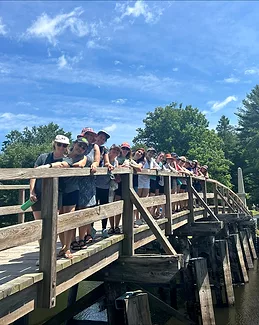
A half-mile section of Battle Road Trail from Meriam’s Corner toward Thoreau’s birthplace offers a chance to consider the landscape, now protected as part of Minute Man National Historical Park, and our own view of the world. Thoreau’s words can be our guide.
The First Online Thoreau Conference, if briefly presented, could be described as a collaborative effort between students, scholars, and educators based in Brazil, who are dedicated to the study and outreach of Henry David Thoreau’s work. However, such a description wouldn’t do much justice to the interconnectedness of readers of Thoreau across the globe.