On May 8, 1859, John Brown was back in Concord. The tall, humorless abolitionist had grown a flowing white beard, making him look like an Old Testament prophet. Like he did during his first visit in 1857, Brown spoke on his anti-slavery activities in Kansas to a large crowd at the Town Hall; he had come east in the hope of raising money for those activities. As in 1857, Ralph Waldo Emerson and Henry Thoreau were again in the audience, and they supported Brown; intellectually, philosophically, and monetarily.
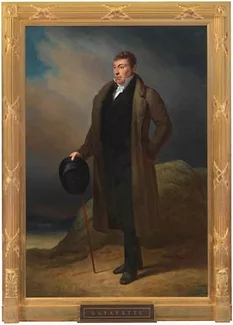
Concord, Massachusetts, is home to two important revolutions: a military one starting on April 19, 1775, and a moral, intellectual, and ideological one, epitomized more than half a century later by the Transcendentalist movement and its staunch support for the abolition of those enslaved in America. Few heroes in American history resonate so strongly with both of these movements as the iconic Frenchman, the Marquis de Lafayette.
In 1837, Concord, Massachusetts was not a town recognized for its great abolitionist stance against slavery. During the 1830s and the 1840s, Concord was a town of nearly 2,000 residents with only a few dozen giving abolitionism much thought — let alone taking any action against slavery.
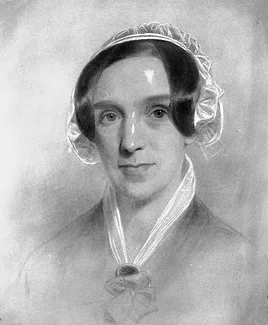
Concord’s transformation from a town that considered abolitionism as something of little concern to a town internationally recognized as a strong hub in the abolitionist movement began in the home of Mrs. Samuel Barrett. For years, prominent Concord women would rotate meeting in each other’s homes and talk of whom and how to help Concord’s neediest residents. They called themselves the Concord Female Charitable Society and the charitable work they accomplished was admirable. The Charitable Society also served as a political voice for these Concord women — a welcome outlet given the prescribed and narrow roles
for women at
that time.
When you hear the words ‘Walden Pond’ you probably think of Henry David Thoreau and his cabin in the woods. If you’ve been here, you might also think of the many hiking trails and sandy little coves surrounding the gin-clear water of the pond where tens of thousands of people enjoy swimming and walking each season.
What you might not think about is the community of formerly enslaved people who once lived near Walden. Not because it was the beautiful, tranquil scene we flock to today, but because it was considered an infertile, out of the way, undesirable piece of land to Concord’s white population.
As Elise Lemire writes in her excellent book Black Walden, as many as fifteen formerly enslaved people ‘made a life for themselves in Walden Woods, enough that Henry David Thoreau could describe their community as a “small village.”’
Close to 500 people gathered at The Robbins House with masks, signs, and an open mind to listen, learn, and add their thoughts to a difficult and painful dialogue happening across the country around inequity and the quest for social justice for people of color. The peaceful gathering of solidarity was organized in less than 24 hours and moderated by Nikki Turpin, Robbins House Programming Chair.
If historical Concord had to be summed up in one sensational newspaper headline it might read something like, “TINY TOWN THAT TROUNCED BRITISH BATALLION ALSO BELOVED BY BOOKWORMS”.
Fortunately, most pilgrims to Concord don’t rely on alliterative excerpts of history when they visit, and yet, there’s so much more to our story than armies and authors. In particular, there is a great deal just waiting to be learned about Concord’s African American history, a complex and very human story that far predates our nation.
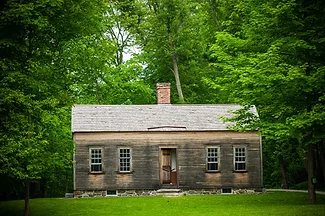
A short drive down Monument Street and across from the venerable Old North Bridge, sits a restored early-19th century vernacular farmhouse, such as can be found all over
New England. What sets this farmhouse apart is that it belonged to the family of Revolutionary War veteran Caesar Robbins, who was enslaved at birth around 1745.
It should come as no surprise that the early laws of this country were derived from English laws, or that those laws were written exclusively by men for men. While Concord of the 19th century was relatively progressive, a wife was still considered merely an extension of her husband, and the laws did not provide her with the right to vote as an individual. Men felt it was good enough for them to cast a vote for both husband and wife, while unmarried women or women of color simply had no say at all.

.webp?height=325&t=1727714275&width=325 "IMG_3783(1).jpg")