
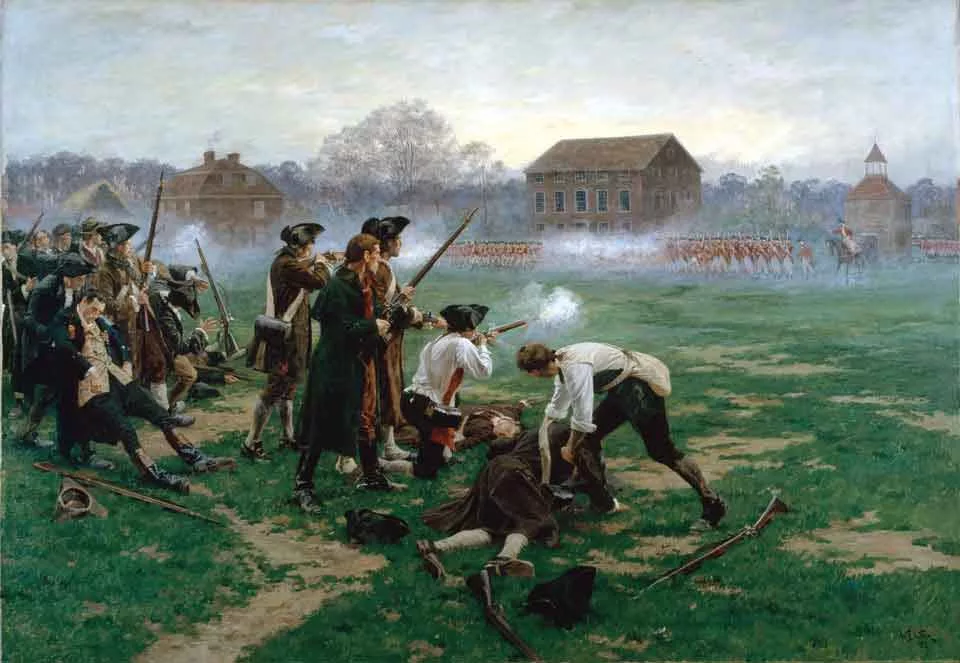
Early on the morning of April 19, 1775, approximately 70 men, all residents of Lexington, Massachusetts, gathered on the Town Green in response to the news that the British Regulars were approaching the town on their way to Concord to search for stores of ammunition. The Lexington men were members of the local militia responsible for protecting their community. Among those Lexingtonians was Prince Estabrook, a man of African descent who was enslaved by Benjamin Estabrook, another Lexingtonian. Whether or not Prince, or any of the other men, were aware of how the events of the morning would play out, it is certain that he did not envision that he was laying the foundation for a new nation. Even so, Prince embodied the events and issues of the day in a way that was distinct from the other men who gathered on the Green that April morning. While his motivation for joining the militia, like other members, may have had multiple inspirations, his personal liberty was no doubt one of them.
The small group of men who had gathered on the Green were not intending to engage the British regiments in a battle. They gathered to demonstrate that there was resistance to the British efforts to dominate their lives. However, the tensions between the two sides erupted into armed confrontation. When the smoke of the rifles cleared and the British soldiers continued towards Concord, Prince Estabrook lay among the wounded. He was taken to the Estabrook home where he was treated by Dr. Joseph Fisk and was soon back in the ranks of the militia, rejoining Captain Parker’s company in Cambridge on June 17, 1775. George Washington had been chosen as commander in chief of the soon-to-be-formed Continental Army just two days earlier. It may have been at this time that Prince Estabrook took the oath of enlistment and enrolled as a soldier in the American continental army.
In 1776, as a member of Captain Mills’ company, Prince marched to Fort Ticonderoga in New York as part of the request for 3,000 soldiers from Massachusetts to replenish troops that had been depleted by battle losses, desertions, and smallpox. He and Pompey Blackman were the only Black soldiers among the 20 men from Lexington who marched to Fort Ticonderoga with Captain Mills’ company. From July to November 1776, they were at Ticonderoga doing the maintenance, repairs, and all the other jobs required to operate the fort. After their service there, they marched 190 miles back to Lexington.
From November 1777 to April 1778, Prince was stationed at Cambridge in Colonel Eleazar Brooks’ regiment of Captain Simon Hunt’s company. They probably had the responsibility of guarding the thousands of Hessian, Canadian, and British soldiers taken prisoner after the Battle of Saratoga.
Prince spent the final years of the war in the Hudson River Valley building and maintaining fortifications as a member of the Third Massachusetts Regiment until October 1783 when he finished his service. The Hudson River Valley, which George Washington referred to as “the key of America,” was one of the most important areas for the colonial army to protect. Prince Estabrook’s time in the Hudson River Valley followed Benedict Arnold’s failed attempt to turn over the fort at West Point to the British.
The treaty ending the war was signed in Paris on September 2, 1783, and two months later, on November 3, 1783, the Third Regiment was disbanded at West Point. On November 25, 1783, the last British troops were evacuated from New York.
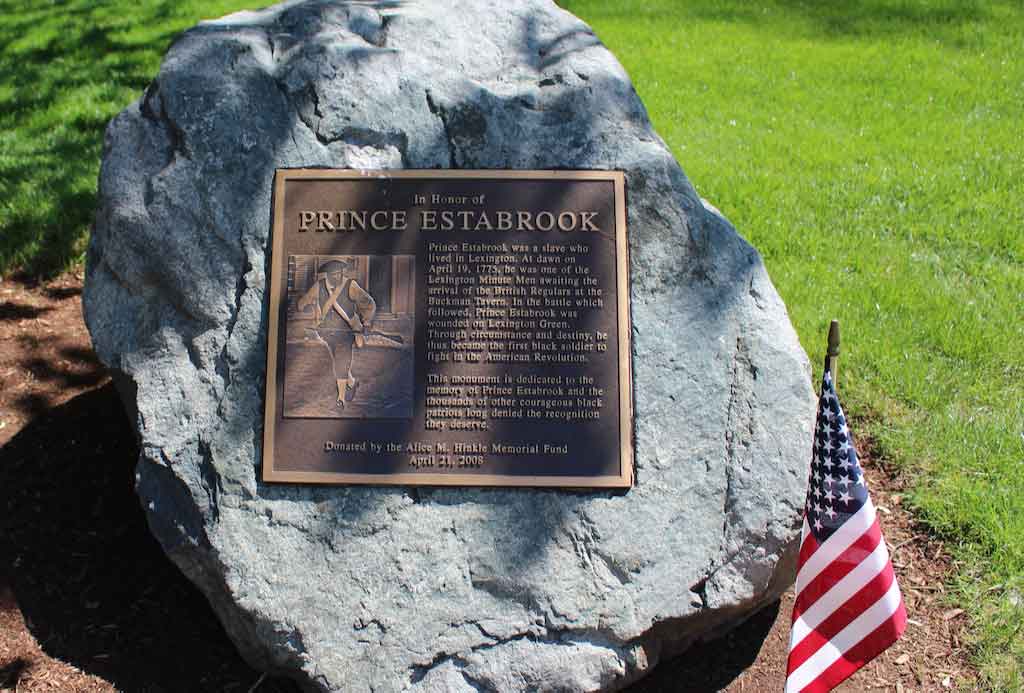
Prince Estabrook Memorial
| Courtesy of Freedom’s Way National Heritage AreaFollowing the war, Prince returned to Lexington where he continued to reside in the home of Benjamin Estabrook; however now he was no longer enslaved by him. It seems that he obtained his freedom because of his service with the colonial militia. Though there is limited information about his life in Lexington, it seems that he was able to support himself and even enjoy some leisure time. He probably continued to work for Benjamin Estabrook doing the same work he had done before, working on the farm and at the mill run by Benjamin. It is possible that he was now paid for his labor. He also probably did odd jobs around the town. As a free resident of Lexington, he was assessed poll taxes, which he was responsible for paying. He was also able to experience a social life as he visited neighboring towns and was able to occasionally partake in a tankard of flip at Munroe Tavern.
Prince Estabrook was only one of the Black veterans of the War of Independence who resided in Lexington in the closing years of the 18th century. He was joined by Lexington residents Silas Burdoo, Moses Burdoo, Eli Burdoo, Isaac Barbados, and Pompey Blackman. They were also joined by Jupiter Free and Samuel Crafts, who had lived in other towns before the war but decided to settle in Lexington after their service.
By 1800, for several reasons, Prince Estabrook was the only one of them who was still living in Lexington. Following Benjamin Estabrook’s death in 1805, Prince removed to the town of Ashby where he lived with Nathan Estabrook, one of Benjamin’s sons. He remained in Ashby until his death in 1830.