
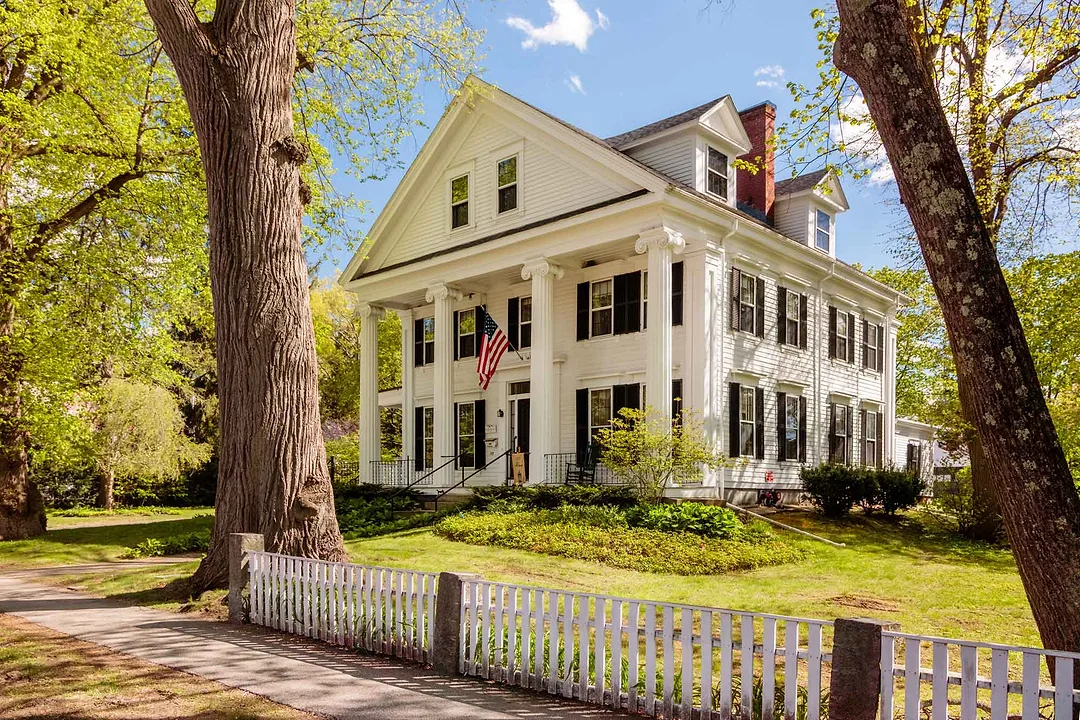
The Timothy Wheeler House, a Greek Revival home with a distinctive columned portico and gabled roof, has housed the Concord Home for the Aged since 1887. It was named for Timothy Wheeler, who owned the site and the land across the street where he operated a grist mill.
Wheeler was a captain in the Concord militia in 1775, responsible for keeping some of the food supply that might be used in the upcoming rebellion. On April 19 when the British regulars searched Concord for weapons and anything to support an army, they found many barrels of grain in the mill. Wheeler persuaded them that the grain was for his business and they left it untouched, allowing it to be available to the Patriot army after the battle that day.
In 1788, Timothy’s son Peter married Phebe Brooks, and in the fashion of the time, his father built them a house on his property at 110 Walden Street. Peter established multiple businesses, but poor management and the embargo of 1812 ruined him. After he died in 1813, his estate was sold off over the course of nine years, due to his large debts. Phebe was assigned their “marriage house” and 30 acres as her widow’s dower.
In 1816, Cyrus Stow and his partners bought the house while honoring the dower arrangement that allowed Phebe to live there for the rest of her life. Phebe’s daughter, also named Phebe, started a school for young children, some of whom grew up to become state judges and legislators, and even a famous writer—Henry David Thoreau.
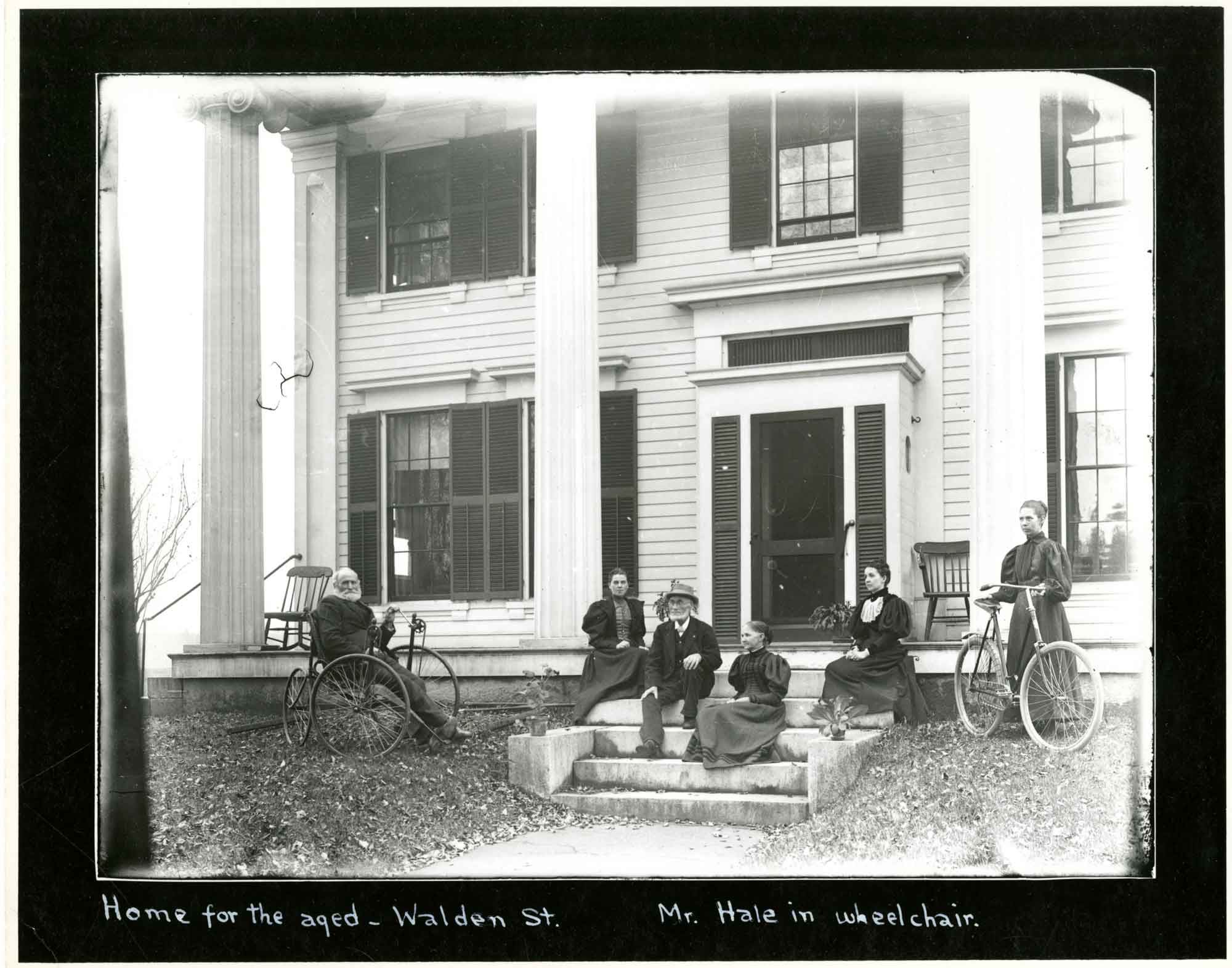
Concord Home for the Aged, circa 1892.
| Courtesy of Concord Free Public LibraryIn 1841, the elder Phebe moved and leased the land back to Stow for $120 per year, until she died in 1847 and the property became Stow’s. He began transforming the house, hiring Thoreau to do the surveying. The current house at 110 Walden was finished in 1851. Stow lived there until he died in 1876.
In 1886, members of the Concord Female Charitable Society—formed in 1814, with decades of providing assistance to the poor and disadvantaged within Concord’s borders—were seeking a building to house needy elderly women.
Affordability was a concern until a longtime member of the society, Martha R. Hunt, offered $20,000 in funding, provided it be a home for both men and women.
110 Walden took on a new life when it was purchased for $5,800. Its new identity, Concord Home for the Aged, was incorporated in January 1887 as a residence for “aged, worthy indigent men and women resident in Concord,” as specified by the gift.
Residents, originally called inmates, had to be at least 60 years old and turn all their assets over to the home. There was a nurse at the house and a matron who held the inmates’ alcohol. The residents at times included some of Concord’s prominent citizens, including former selectman, horticulturalist, and developer of the Concord grape Ephraim Wales Bull, who died there in 1895.
The house retains many of its original windows, panes, hardware, shutters, and exterior woodwork. There is no longer a requirement for turning over all of one’s assets. A room with private bath, three meals a day, laundry, cleaning, two sitting rooms with TVs, and 24-hour staffing are provided. Residents need to be 65 or older, ambulatory, and come from Concord or its environs or have a Concord connection.
Today, Concord Home for the Aged—the Timothy Wheeler House—remains an affordable option in a warm, family-like setting. It’s a unique oasis in the heart of Concord for its very fortunate group of residents. Visit TimothyWheelerHouse.com.
From a report by Anne McCarthy Forbes, architectural historian; Karle Packard, AIA, Red Hawk Studio Architects, Inc.; and Lawrence A. Sorli, historical architect.