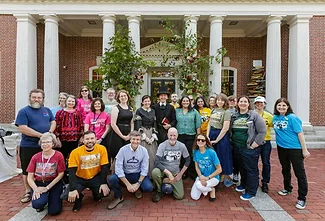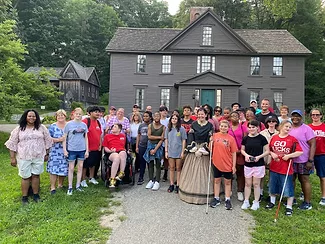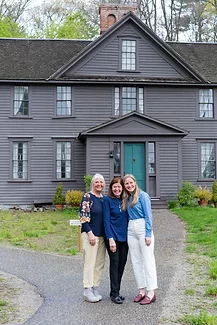

Take one beloved band director with vision, add 25 blind marching band students;
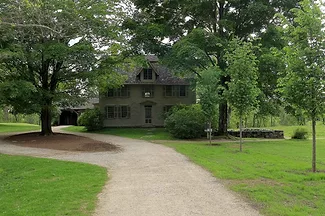
mix well in Louisa May Alcott’s Orchard House and voila! You have an extraordinary, never-to-be forgotten experience.
There are some tales that have so seeped into a place that it is best to leave them be or risk upsetting the spirits who dwell within. But sometimes, even if you mind your own realm, the spirits come out and find you.
Colonial Concord was a small subsistence-level farming community. By the eighteenth century, provincial Concord was three times larger (1,500 people) and six times wealthier due to a rapid rise in commerce and manufacturing. The white cottages on the church green reflect Concord’s transformation.
Completely unaware of the existence of Louisa May Alcott’s Orchard House, Julie Nass and her daughters had developed a deep affection for Little Women, reading the book multiple times and watching all the movie adaptations as a family on their small Wisconsin dairy farm. The Little Women musical, which debuted on Broadway in 2005, was youngest daughter Hannah’s favorite.
Ralph Waldo Emerson lived in Concord for most of his life and probably explored almost every inch of it on foot. As he once said, “I go through Concord as through a park.” Today, we can follow in the footsteps of the “Sage of Concord.”
“Perhaps some of these summers we may see a band of pilgrims coming up to our door…”1 Louisa May Alcott wrote in 1874 to the Lukens sisters, five girls living in Pennsylvania who had begun a pen pal correspondence with their favorite author.
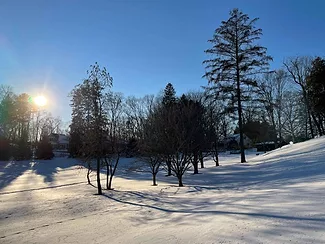
There’s a joke that goes: “What are the four seasons in New England? Winter, still winter, and three months of bad sledding.” Any shrewd Yankee – or wise visitor – chuckles at this saying but knows it just ain’t true. Rather, winter in the northeast is a wonderland of opportunity. As the sage Henry David Thoreau observed, “a healthy man, indeed, is the complement of the seasons, and in winter, summer is in his heart.” And in Concord, where Thoreau tread across snowy dells and meadows blanketed in white, hearts are “warm and cheery, like cottages under drifts, whose windows and doors are half concealed, but from whose chimneys the smoke cheerfully ascends.”
Every year, more than a million people descend on Minute Man National Historical Park to bear witness to the events that started the American Revolution. For the vast majority, North Bridge is the focal point, the place where visitors can literally walk over history while admiring the setting along this notable stretch of the Concord River.
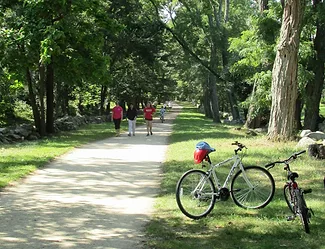
A growing number of travelers and national park aficionados are exploring more of the 1,034 acres that comprise Minute Man. That includes nine miles of walking trails! While history remains its cornerstone, Minute Man is also a national park, a welcome oasis offering an outdoor escape to the metropolitan Boston area.
In 2002, a volunteer group of citizens formed The Friends of Sleepy Hollow Cemetery with the mission focused on the continuing enhancement and beautification of and furthering education about that Concord treasure. Guided by a Board of Directors, with full appreciation to those supporters who contribute through an Annual Appeal and otherwise, and in liaison communication and collaboration with the Town’s Cemetery Committee, the organization has successfully continued for two decades, and goes on.
Henry David Thoreau’s cabin at Walden Pond is his most famous residence, yet historians and scholars also credit several other sites in Massachusetts that served as “home” to this American literary figure. Looking into Thoreau’s past offers a glimpse into how his early years played a role in shaping the artist he would eventually become.