Two white horses pulled the hearse into Concord’s Sleepy Hollow Cemetery, a top-hatted driver at the reins. A band of mourners followed on foot as they made their way toward Authors’ Ridge.
Except for the bright sunshine, this scene wouldn’t seem out of place in a story by Nathaniel Hawthorne. But it happened a mere twenty years ago, on June 26, 2006. That was the day Hawthorne and his wife and daughter were reunited after his death separated them 142 years earlier.
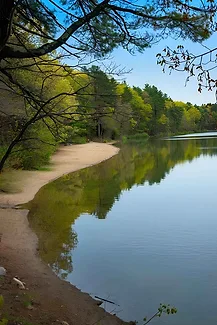
Few American writers are as closely connected to a place as Henry David Thoreau (1817–1862). The landscapes of Concord and the surrounding towns—today part of Freedom’s Way National Heritage Area—shaped his ideas, inspired his writing, and helped define a philosophy that continues to influence readers around the world.
This itinerary follows Thoreau’s journey through the places that mattered most to him. From his birthplace at Thoreau Farm to his final resting place in Sleepy Hollow Cemetery, these homes, buildings, fields, forests, and waterways reveal the people and topography that helped form one of America’s most influential thinkers.
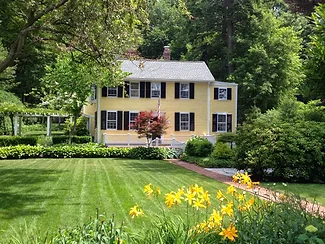
Few places in the United States offer a wealth of history, literature, anthropological clues, and examples of Early American architecture along a one-mile stroll. Concord’s American Mile invites you to enjoy the great outdoors while learning about the town’s fascinating history. Begin your adventure at Monument Square and head east along Lexington Road.
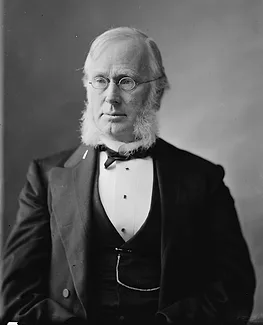
From almost the very beginning of Concord’s founding in 1635, the Hoar family played a prominent role in the town’s history. Recognized for their leadership in law, politics, and social reform, in addition to their distinguished legal and political careers, the Hoars shaped both local government and national policy. Described as “leaders to a higher and better sphere, both in social and political sense,”1 they were better known around town—and throughout Massachusetts—as the Royal Family of Concord. And none of them lived up to the family ideal of public service better than George Frisbie Hoar.
Lexington and Concord. April 19, 1775. Where and when the Revolutionary War started is well known.
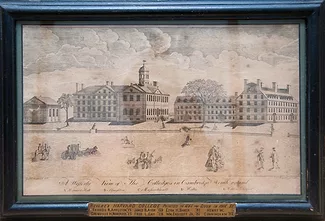
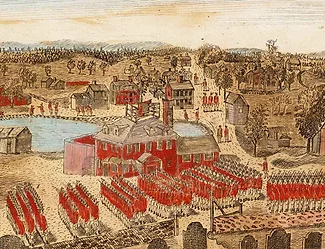
Not so well known is the fact that Harvard played an important, if odd, role afterward in the early days of the Revolution, turning its campus over to the nascent American army. On May 1, 1775, undergraduates were dismissed and given an early summer vacation. Classes resumed on Oct. 5 in Concord, 20 miles away — the beginning of a wartime academic sojourn.
In colonial America, taverns were commonplace throughout Freedom’s Way National Heritage Area. But these early American taprooms were much more than just watering holes. They served an important purpose in the community as a place for townsfolk to gather and plan. This proved especially important in the years leading up to the Revolution. Taverns became Patriot refuges, where decisions were made about separation from the Crown and what a more democratic form of government would look like. As British-colonial relations finally boiled over, taverns became meeting spots for Patriot militias to assemble and prepare for battle.
This year, the Trinitarian Congregational Church (TriCon) on Walden Street is celebrating its 200th anniversary. However, from the early days of Concord’s founding in 1635, there was only one meeting house, and that was First Church in the center of town. In 1778, Reverend Ezra Ripley assumed
the pastorate, a position he would
hold for 63 years. By 1825, First Parish, like many Congregational churches
in Massachusetts, had changed, adopting a Unitarian theology. But
not all parishioners were happy with
“Dr. Ripley’s church” or his unorthodox preaching. In March 1826, nine dissenters, joined by seven townspeople, left First Parish to form their own “religious conference.”
Concord Center takes justifiable pride in its history, but today great things are happening in West Concord. Innovation and self-reliance are nothing new on the west side of Route 2; they’ve defined the community for centuries.
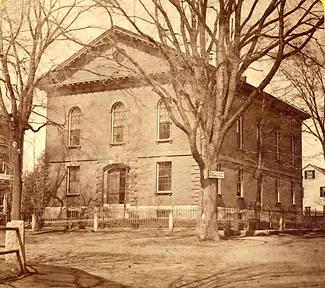
The Lyceum Movement started in New England in 1826, when educator and scientist Josiah Holbrook founded the first lyceum in Millbury, Massachusetts. Inspired by the classical Lykeios (Λύκειος) in Ancient Greece, where Aristotle taught, the movement was created to bring education to ordinary people through lectures, debates, and readings. Lyceums quickly spread across New England, fostering education, self-improvement, and civic engagement, and many towns soon formed lyceums of their own, including Boston in 1829 and Salem in 1830. By the 1830s, there were Lyceums across the country.
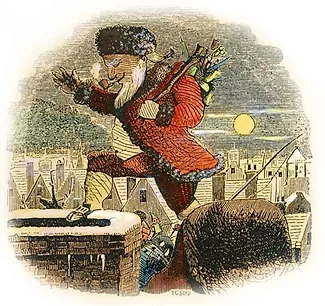
When November rolls around each year many Americans begin to think about the upcoming holidays. Traditional family recipes are dusted off for Thanksgiving as relatives and friends are invited to share the feast. Almost as soon as dinner is over, thoughts turn to Christmas as decorations, presents, and parties become the center of attention. Many of our holiday traditions date back to the 19th century, and modern Americans would easily recognize their ancestor’s Thanksgiving and Christmas celebrations.