In the early morning of April 19, 1861, Daniel Lawrence rode into the town of Concord on horseback, rousing the town militia with orders to report to Boston in response to President Lincoln’s call for militia volunteers. The method and timing of this call were no accident.
Stand in the middle of Concord’s North Bridge with the Minute Man statue on your right and the British soldiers’ grave on your left. Place your hands on the rough wooden handrail in front of you; slightly to the left, you will see The Old Manse through the trees. Peer down into the Concord River that Ralph Waldo called “the dark stream which seaward creeps” and brace yourself: this tale is about to get rough.
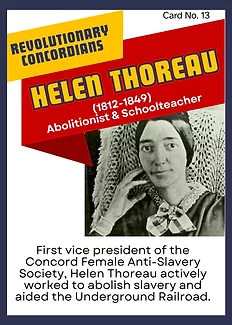
Concord’s history is filled with revolutionaries—not just the famous names we learn in school, but everyday people whose courage and vision helped define Concord as it is today. Now, there’s a brand-new way to learn about these trailblazers: the Revolutionary Concordians Trading Card Game, developed by Thoreau Farm with funding from Freedom’s Way National Heritage Area. This interactive, town-wide experience invites people to connect with Concord’s history like never before, all while exploring the businesses, cultural institutions, and landmarks that make the town special today.
In a world where men claimed to have all the answers, Margaret Fuller made it her mission to ask all the right questions. “How came I here?” she wrote as a young adult. “How is it that I seem to be this Margaret Fuller? What does it mean? What shall I do about it?” She was only a visitor in Concord, but this town was electrified by her presence.
Last fall, the Town of Concord and Concord250 were proud to be among the 37 selected recipients of a Massachusetts250 Grant provided by the Healey-Driscoll Administration and the Massachusetts Office of Travel and Tourism. The grant funded the project “A Fight for Freedom: Honoring Patriots of Color.”
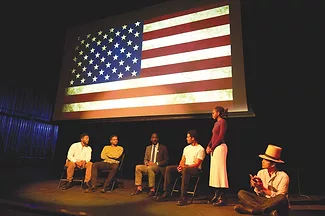
For many months, scholars, interpreters, and artists collaborated to create this signature event. The program launched in March at The Umbrella Center for the Arts with a two-hour live event dedicated to uncovering and honoring the often-overlooked contributions of Black and Indigenous Patriots during the American Revolution and the ongoing struggle for freedom and equality over the past 250 years.
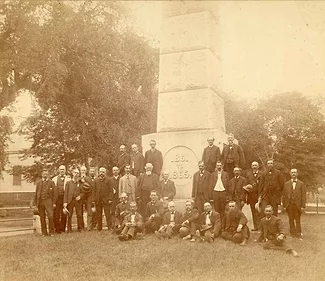
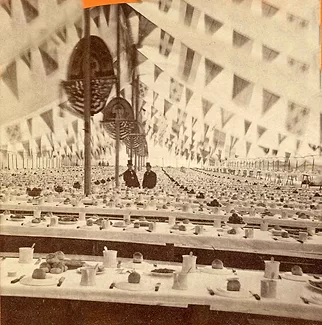
April 19, 2025 marks the semiquincentennial, or 250th anniversary, of the historic battles of Concord and Lexington. To mark the occasion, from April through June 2025, in collaboration with the Town Archives, the William Munroe Special Collections at the Concord Free Public Library will present an exhibition on Concord’s April 19 anniversary traditions. The exhibition features a lecture by Michael D. Hattem, a historian of the American Revolution and historical memory. We are excited to share some highlights from anniversary events held in Concord over the past 250 years. We hope they will get you in the spirit of the upcoming festivities!
The Robbins House was originally located on an isolated farm overlooking the Great Meadows along the Concord River. The first two families who lived there were descendants of Caesar Robbins, a Revolutionary Patriot of color, and the house is one of the only known historic sites commemorating the legacy of a previously enslaved Revolutionary War veteran. In 1823, Caesar’s son Peter Robbins purchased the new two-room house and over 13 acres for $260.
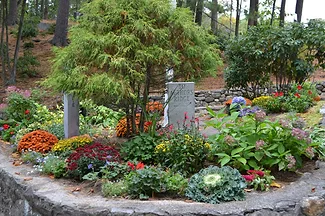
In the fall of 2002, a group of Concord residents formed The Friends of Sleepy Hollow Cemetery with the mission to provide leadership to beautify, enhance, and advance the Cemetery, one of Concord’s treasures.
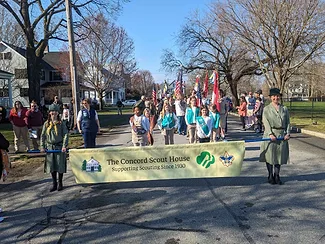
Step back in time at Concord Scout House, where history and community converge in a beautifully preserved New England barn. As you approach down the pine-lined driveway, the white clapboard building emerges like a hidden treasure in the heart of historic Concord.
The Concord Scout House stands on land that was farmed dating back to the founding of the town of Concord. The property, 74 Walden Street, was part of land owned by Timothy Wheeler during the American Revolution. Wheeler was known for successfully hiding colonial supplies from the British troops on April 19, 1775. After a succession of farming owners, The Concord Massachusetts Girl Scouts, Inc. acquired the land with the barn from the Stow family in 1930.
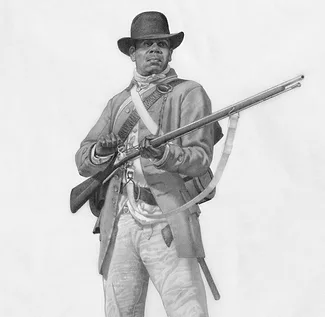
On April 19, 1775, an estimated twenty to forty colonists of African or Native American descent fought in the first battle of the American Revolution. On that historic day, those men, often termed “Patriots of Color,” joined approximately 4,000 other men fighting British Regular soldiers along the “Battle Road” from Concord to Boston. Over the last 250 years, racism and historical bias have effectively ignored or trivialized the contributions of those men and many other people of color in the historic struggle that produced the United States. To understand who the Patriots of Color were, how they contributed to the American Revolution, and why they chose to do so, we must examine their social context.


.webp?height=325&t=1750270539&width=325 "_TRH_Winter_Candles_A-(2).png")