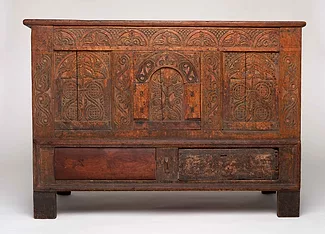
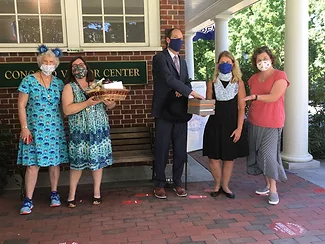
Museums do not often get to reinvent themselves, but the Concord Museum seized this once-in-a-generation opportunity after renovating their main building and constructing a new Education Center in 2018. Years in the making, the curatorial team took advantage of over a dozen empty galleries and a world-class collection and embarked on a major project that would transform the Concord Museum and visitor experience. This August, that exciting and challenging process concluded with the opening of ten new permanent galleries.
It was April 1900, and the First Parish in Concord was putting the finishing touches on a splendid renovation of its historic meetinghouse on Lexington Road. No expense had been spared, for in a few days the parish would celebrate Easter Sunday, and less than a week later, the town would gather in its pews to honor the 125th anniversary of the minutemen’s victory at
the North Bridge.
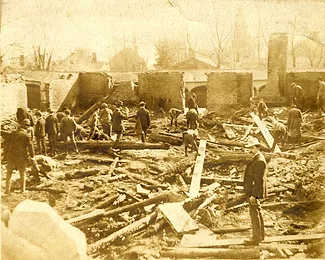
If, on a summer day, you drive down Sudbury Road toward Nine Acre Corner, then, having left the shade of the woods and passed by a line of sunlit fields, you will see a squat brown building standing amidst the rows of crops. This is the farm stand of Verrill Farm. This local family business has gone through many shapes and sizes over the course of its 100-year history, surviving economic changes and even a devastating fire, but it has always carried on in its mission to “nourish the body and soul of our customers by providing healthful food of superb flavor in surroundings of beauty.”
In her pioneering book Woman in the Nineteenth Century (1845), writer and thinker Margaret Fuller articulated the goal of women’s progress in America: “We would have every arbitrary barrier thrown down. We would have every path laid open to Woman as freely as to Man.” Spoken seventy-five years before women had the legal right to vote, Fuller’s words served as a rallying cry for generations of people who fought to live and work as they pleased.
On April 19, 1775, the long-simmering uneasiness between the American colonies and the British Crown broke out into open warfare with the Battles of Lexington and Concord. A year later, rebellion turned into revolution and, in 1783, after eight years of war, the United States of America gained its independence from Great Britain.
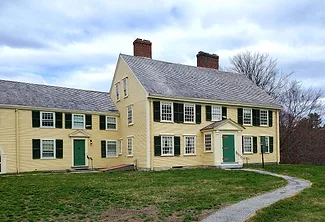
Today, visitors to Minute Man National Historical Park can experience firsthand where the American Revolution began. The Park passes through three towns; from the Battle Green in Lexington, past the Hartwell Tavern and Bloody Angle in Lincoln, and westward to the Old North Bridge in Concord. Parts of the five-mile-long Battle Road Trail literally follow in the footsteps of the Colonial militia and British Redcoats. Along the way, there can be seen many buildings, called “Witness Houses” by the National Park. These were the homes and farms of the people who lived here in the 18th century, and these houses bear mute testimony to the violence, chaos, and bloodshed of April 19, 1775.
Here are four of the eleven historic buildings you’ll see on the Battle Road Trail, highlighting the lives of the people who experienced the first day of the American Revolution.
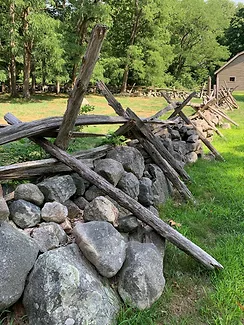
When thinking of famous walls in history, what are the first that come to mind? The Great Wall of China, Hadrian’s Wall, and the Berlin Wall are all common answers. What about the stone walls at Minute Man National Historical Park? Those simple barriers might not be the first wall you think of, but their role in history is just as important as the more well-known walls.
The COVID pandemic strained communities around the globe, and Concord was no exception. We watched as friends and neighbors struggled with loss, illness, and financial crisis. We lost friends and loved ones of our own. And in our beautiful town, we saw shops and restaurants that had been a part of the town’s fabric for decades shutter their doors forever. The call for help was loud and clear.
A very long time ago, before Hallmark was even a twinkle in the corporate eye, reverence for mothers was expressed in stories that were shared and passed on, rather than greeting cards. Take for example the ancient Egyptian tale of Isis, who really, really wanted to have a baby with her husband Osiris. The fact that Osiris was dead and probably dismembered was but a trifle to a competent mother-to-be like Isis, and accordingly, she reassembled and resurrected her late husband just long enough for him to participate in the conception of their son. The end result was baby Horus who would grow up to become the first ruler of a unified Egypt, thus ensuring Isis’ new title and esteem as Mother of the Pharaohs.
Shock. Anger. Patriotism. Resolve. These were just some of the emotions that swept through the Northern states when Confederate forces fired on the Federal-held Fort Sumter in Charleston Harbor, South Carolina on April 12, 1861. The Civil War had begun.
Two days after Sumter’s surrender, President Lincoln issued a call for 75,000 volunteers to put down the rebellion. Massachusetts answered the call with an overwhelming response, and nearly 160,000 Bay Staters would serve in the Union army and navy. Like the rest of the North, the people of Concord were angered and inspired, and the town of just over 2,000 inhabitants would ultimately do its part by sending 450 men off to the war.