Winters in New England can be harsh and unforgiving with days, or even weeks, of below-freezing temperatures and with snowfalls that are often measured in feet. It’s a season when all but the heartiest of New Englanders hunker down, put on a few extra layers of flannel, crank the thermostat, and stay cozy and warm at home.
One Concordian who enjoyed the winter, though, was Henry David Thoreau. He would happily go on his daily walk “in all seasons” and a wintery landscape held just as much promise for an exciting excursion as did the fields and forests in July.
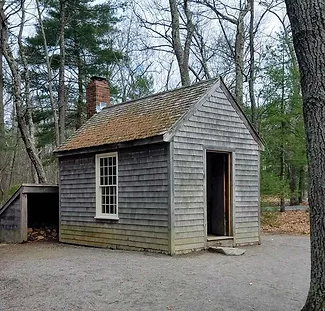
On September 6, 1847, Henry Thoreau left his small house at Walden Pond and moved back into the town of Concord. Having lived at Waldon Pond for over two years, he was, he would write, “a sojourner in civilized life again.”
In the mid-1830’s, a new word entered the American lexicon; Transcendentalism. It was a word that was vague and confusing, a word that seemed mystical, spiritual, and possibly even blasphemous. Even today, 170 years later, Transcendentalism is still misunderstood, and many people have a hard time explaining what it was and what it means.
Lexico.com defines Transcendentalism as
“an idealistic philosophical and social movement which developed in New England around 1836 in reaction to rationalism. Influenced by romanticism, Platonism, and Kantian philosophy, it taught that divinity pervades all nature and humanity, and its members held progressive views on feminism and communal living. Ralph Waldo Emerson and Henry David Thoreau were central figures.” Simply put, it is the idea that God is present in all things, that we are surrounded by divinity. All of nature is divine, and therefore, since man is a part of nature, we have the capability to be divine as well.
We all know the old adage, “Behind every great man there is a great woman.” In fact, throughout history many women have distinguished themselves just as much as their men. Women such as Abigail Adams, Dolley Madison, Eleanore Roosevelt, or Jackie Kennedy were a force to be reckoned with in their own right, their place in history assured. Here in Concord, our “Two Revolutions” revolved around the names Ripley, Emerson, Hawthorne, and Thoreau. But these great men were surrounded by equally impressive and influential women, who also played a pivotal role in our nation’s history. We would like to share a few of their stories here…
Among the luminaries buried at Sleepy Hollow Cemetery, few made greater sacrifices for their nation than did Asa, John, and Samuel Melvin. Their story echoes down the years and reflects the courage, commitment, and integrity of one of Concord’s oldest families.


.webp?height=325&t=1727739838&width=325 "566px-Paul_Revere's_ride-(1).jpg")