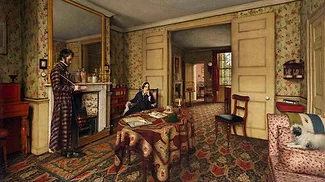
Of all the writers and philosophers who influenced the New England Transcendentalists, none had a bigger impact than Thomas Carlyle. Born in Scotland in 1795, as an essayist, historian, and philosopher, Carlyle had a profound influence on the 19th century, not just in the United Kingdom, but also in America, particularly with the writers in Concord, Massachusetts.
Virtually every member of the Transcendentalist circle read Carlyle’s writings with great enthusiasm; Bronson Alcott, Orestes Brownson, Theodore Parker, William Henry Channing, Ralph Waldo Emerson, Margaret Fuller, Frederic Henry Hedge, George Ripley, and Henry Thoreau all drew inspiration from Carlyle. In particular, it was his writings on Germanic literature that lit a flame under the Transcendentalists.
By 1845, the careers of Nathaniel Hawthorne and Edgar Allan Poe were on very different tracks. Hawthorne was a struggling writer living in Concord, Massachusetts, while Poe was in New York City, a celebrated writer and literary critic known around the country. Yet, in the 1840s, the two men’s careers became briefly entwined.
With the end of the French and Indian War in 1763, Great Britain was now in control of North America: the 13 British colonies along the seaboard were safe and sound from their enemies, while all French territory east of the Mississippi, as well as Spanish Florida, now belonged to King George III. For the first time since 1701, Great Britain was at peace. But the empire was also broke.
This spring marks the 180th anniversary of Samuel Melvin’s birth on April 9, 1844. While the entire family would be deeply and tragically affected by the Civil War, Samuel, the fourth child and third son, went through a particularly hard time while serving in the Union Army. This is the story of his Civil War.
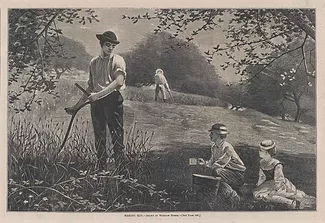
By the middle of the nineteenth century, Concord had just turned 200 years old and had a population of around 2,000. Always a farming town, by the 1840s, Concord’s agricultural economy was in flux, and the crops and farms that had been so important to the town in its first 200 years were evolving. By the dawn of the twentieth century, Concord agriculture had changed in many ways, from the people who were farming to the crops they were growing.
“October is the month for painted leaves,” Henry Thoreau wrote in 1860. “Their rich glow now flashes round the world.” And while it’s true that other parts
of the world experience autumnal tints every year,
they seem to be brighter and more vivid in New England.
Spring is a time of rebirth, and with the melting of snow we begin to think about the blooming of flowers and the budding of trees as nature reawakens after her winter slumber. But in Concord, the arrival of spring brings to mind more warlike notions, and the sights and sounds of marching redcoats and militiamen fill the town as Concord commemorates the April 19, 1775, Battles of Lexington and Concord.
Winters can be long and harsh in New England, but at least we have hope every year that, soon enough, spring and then summer will make their return. But what if warmer weather never returned? That’s exactly what happened in 1816, The Year Without a Summer.
On July 9, 1842, a small wedding took place at the bookstore of Elizabeth Peabody at 13 West Street in Boston. After a highly secretive three-year engagement, 38-year-old struggling novelist Nathaniel Hawthorne married 33-year-old Sophia Amelia Peabody, the younger sister of the bookstore owner.
Henry David Thoreau loved springtime. While it’s true that he had something to say about every season, he seemed to wax more poetic not only in the spring but about the spring. When the earth came alive after a long cold winter, Thoreau’s observations came to life as well.


.webp?height=325&t=1721414148&width=325 "thumbnail_23352783_119738483026-(1).jpg")