The abolitionists of the 19th century valued, revered, and lived by the words of the Declaration of Independence. The proclamation “We hold these truths to be self-evident, that all men are created equal, that they are endowed by their Creator with certain unalienable Rights, that among these are Life, Liberty and the pursuit of Happiness” affirmed that all individuals possess equal human dignity. The abolitionists lived in one era when our country was not living up to those words, and as we celebrate the 250th anniversary of the Declaration of Independence, like them, we find the promise of those words again in peril.
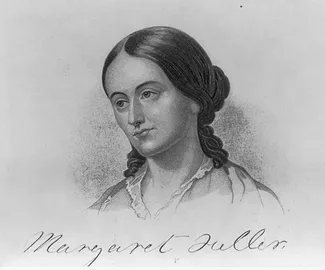
Transcendentalist and feminist writer Margaret Fuller—Emerson’s friend and collaborator, Bronson Alcott’s colleague, Thoreau’s first editor, and Ellery Channing’s sister-in-law—was central to Concord’s literary and intellectual life. She first came to Concord in the summer of 1836, when she met Emerson and stayed with his family for three weeks.
In a world where men claimed to have all the answers, Margaret Fuller made it her mission to ask all the right questions. “How came I here?” she wrote as a young adult. “How is it that I seem to be this Margaret Fuller? What does it mean? What shall I do about it?” She was only a visitor in Concord, but this town was electrified by her presence.
In the summer of 1842, Concord was like any other New England town. Sitting 18 miles west of Boston, the town of 2,000 souls was still very rural. The railroad wouldn’t come through for another two years, and there was no telegraph yet; only the daily stagecoach and the post office connected Concord to the rest of the world.
Margaret Fuller (1810-1850) was a “feminist” before the word existed.
Fuller’s father rigorously educated his eldest child as if she were a son, bestowing on her a formative belief in the gender-equality of the mind and spurring her own career as a teacher. In her thirties, Fuller’s erudite reputation preceded her as a leader in the emerging Transcendentalist movement, a philosophy that revitalized the role of the individual in society in the decades preceding the American Civil War. Along with Elizabeth Peabody, Sophia Ripley, Abigail May Alcott, and Lidian Emerson, Fuller was among those women who actively shaped Transcendentalism and used its impetus to further social aims.