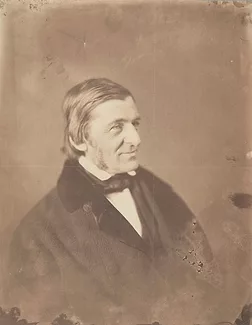
The Lyceum Movement started in New England in 1826, when educator and scientist Josiah Holbrook founded the first lyceum in Millbury, Massachusetts. Inspired by the classical Lykeios (Λύκειος) in Ancient Greece, where Aristotle taught, the movement was created to bring education to ordinary people through lectures, debates, and readings. Lyceums quickly spread across New England, fostering education, self-improvement, and civic engagement, and many towns soon formed lyceums of their own, including Boston in 1829 and Salem in 1830. By the 1830s, there were Lyceums across the country.
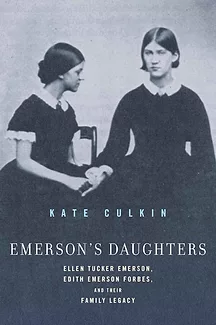
In her engaging biography, Emerson’s Daughters, Kate Culkin brings out of the shadows two of “Concord’s favorite daughters,” Ellen and Edith, who had a “sisterhood built on correspondence,” and whose contributions have been all but lost until now.
As tensions between the North and South increased throughout the 1850s, Ralph Waldo Emerson, like many Americans, was becoming more resigned to the prospect of civil war. He was convinced that the “insanity” of the South’s attachment to slavery would soon tear the nation apart.
On the list of Concord’s notable 19th century women about whom few people know is Lidian Emerson Jackson; so little is written of her many talents, quiet fortitude, and unwavering support of her famous husband, Ralph Waldo Emerson.
She was Waldo’s second wife, succeeding his marriage to Ellen Tucker in 1829.
Of all the writers and philosophers who influenced the New England Transcendentalists, none had a bigger impact than Thomas Carlyle. Born in Scotland in 1795, as an essayist, historian, and philosopher, Carlyle had a profound influence on the 19th century, not just in the United Kingdom, but also in America, particularly with the writers in Concord, Massachusetts.
Virtually every member of the Transcendentalist circle read Carlyle’s writings with great enthusiasm; Bronson Alcott, Orestes Brownson, Theodore Parker, William Henry Channing, Ralph Waldo Emerson, Margaret Fuller, Frederic Henry Hedge, George Ripley, and Henry Thoreau all drew inspiration from Carlyle. In particular, it was his writings on Germanic literature that lit a flame under the Transcendentalists.
In the summer of 1842, Concord was like any other New England town. Sitting 18 miles west of Boston, the town of 2,000 souls was still very rural. The railroad wouldn’t come through for another two years, and there was no telegraph yet; only the daily stagecoach and the post office connected Concord to the rest of the world.
In the wild places of Concord linger old Puritan superstitions and Transcendental possibilities. We begin in the year 1620 when, bearing sea-weary Puritan separatists, the Mayflower arrived off Cape Cod’s coast revealing what Pilgrim leader William Bradford noted as “a hideous and desolate wilderness, full of wild beasts.”
To the Puritans, the Wilderness was the devil’s territory. Satan would not linger in the exposed coastal regions where the Puritans first settled and kept him at bay with devout prayer, but he was always there, in the wild forests, the swamps, the unexplored places, tempting them to leave the seaside settlements of early Massachusetts and stray from righteousness.
The Marquis de Lafayette visited Portland, Maine during a grand tour of the United States in 1825. When Mary Moody Emerson—fifty years old at the time—was introduced to the aging hero of the American Revolution, she told him she was “‘in arms’ at the Concord Fight.”1
It was a joke, but as always, her wit had an edge of truth. She was indeed present for the “shot heard ’round the world,” but the “arms” she was in were her those of her mother, clutching eight-month-old Mary as the battle raged 150 yards from her window at the Old Manse.
Ralph Waldo Emerson was not the originator of the romantic ideals known as Transcendentalism. Nor was his premier essay, Nature (1836), the first publication to set forth the philosophy. Emerson was, rather, the most successful public voice of New England Transcendentalism in the nineteenth century. Dissatisfied with his traditional ministry, Emerson embarked on an untried profession as a lecturer, essayist, and poet; gaining an international reputation. His eloquent and provocative prose resonated with a young American republic yearning to define itself against the time-honored past. Emerson turned his personal search for meaning into a national paean for a self-actualized identity. Nature was closely followed by his controversial “American Scholar,” “Divinity School Address,” and iconic “Self-Reliance.”
In the mid-1830’s, a new word entered the American lexicon; Transcendentalism. It was a word that was vague and confusing, a word that seemed mystical, spiritual, and possibly even blasphemous. Even today, 170 years later, Transcendentalism is still misunderstood, and many people have a hard time explaining what it was and what it means.
Lexico.com defines Transcendentalism as
“an idealistic philosophical and social movement which developed in New England around 1836 in reaction to rationalism. Influenced by romanticism, Platonism, and Kantian philosophy, it taught that divinity pervades all nature and humanity, and its members held progressive views on feminism and communal living. Ralph Waldo Emerson and Henry David Thoreau were central figures.” Simply put, it is the idea that God is present in all things, that we are surrounded by divinity. All of nature is divine, and therefore, since man is a part of nature, we have the capability to be divine as well.


.webp?height=325&t=1727737362&width=325 "PastedGraphic-4-(3).jpg")