
The road to American independence took time to complete, and Massachusetts, despite its reputation as a vanguard state, was not always in the lead. In 1775, even after the battles of Lexington and Concord and Bunker Hill, most Patriot leaders were still seeking restoration of colonial rights within the British empire. Thomas Paine broke the logjam with the publication of Common Sense early the next year. The instant best-seller argued the case for separation by appealing to economic and political self-interest, emotional resentment of a brutal and oppressive king, and a utopian vision of America as “an asylum for mankind.” Even so, hesitation was widespread, especially in the Middle Colonies. Not until late April, a year after the fighting had started, did the push for independence begin in earnest, when several Virginia counties instructed their representatives to repudiate the connection to Britain at the next colony-wide convention.
Massachusetts then stepped forward with a bold action little remembered today. On May 1, 1776, the General Court declared a de facto independence. Under the royal charter, the authority of law derived from the Crown. Writs for town meetings were issued in “his Majesties name.” So were commissions for office. But how could government claim legitimacy from a monarch, who rejected their petitions for redress of “great and manifest” grievances with “scorn and contempt,” who treated their resistance to “servile subjection” as “rebellion” and launched an “unjust war” against them, “wasting, spoiling and destroying the country”? To rule “in the name and stile of the King of Great Britain” was a manifest “absurdity,” declared the lawmakers. Starting June 1, all legal proceedings would be conducted “in the name and stile of the Government and People of Massachusetts Bay in New England.” Ahead of its sister colonies, Massachusetts became an independent republic with the stroke of a pen.1
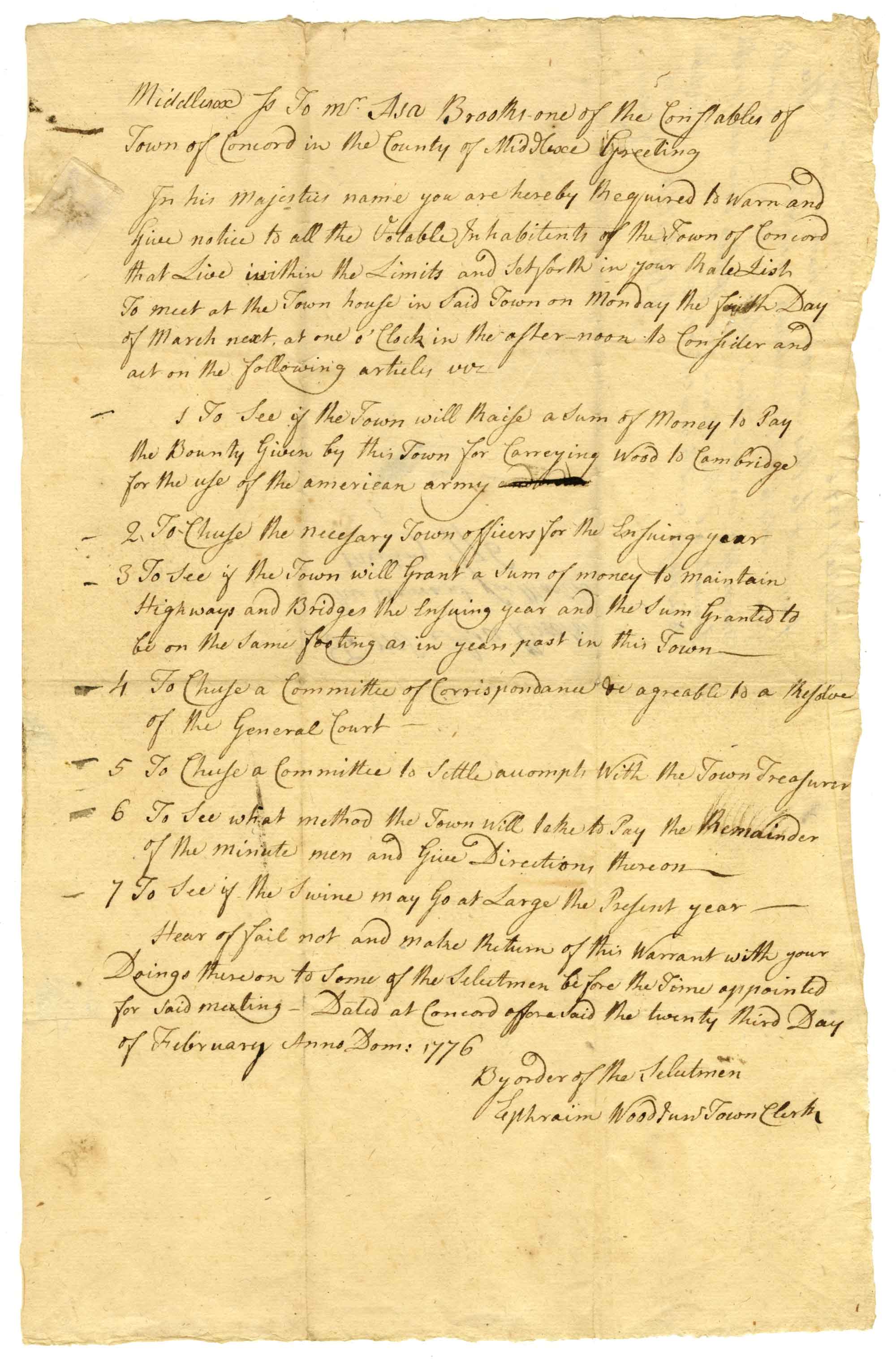
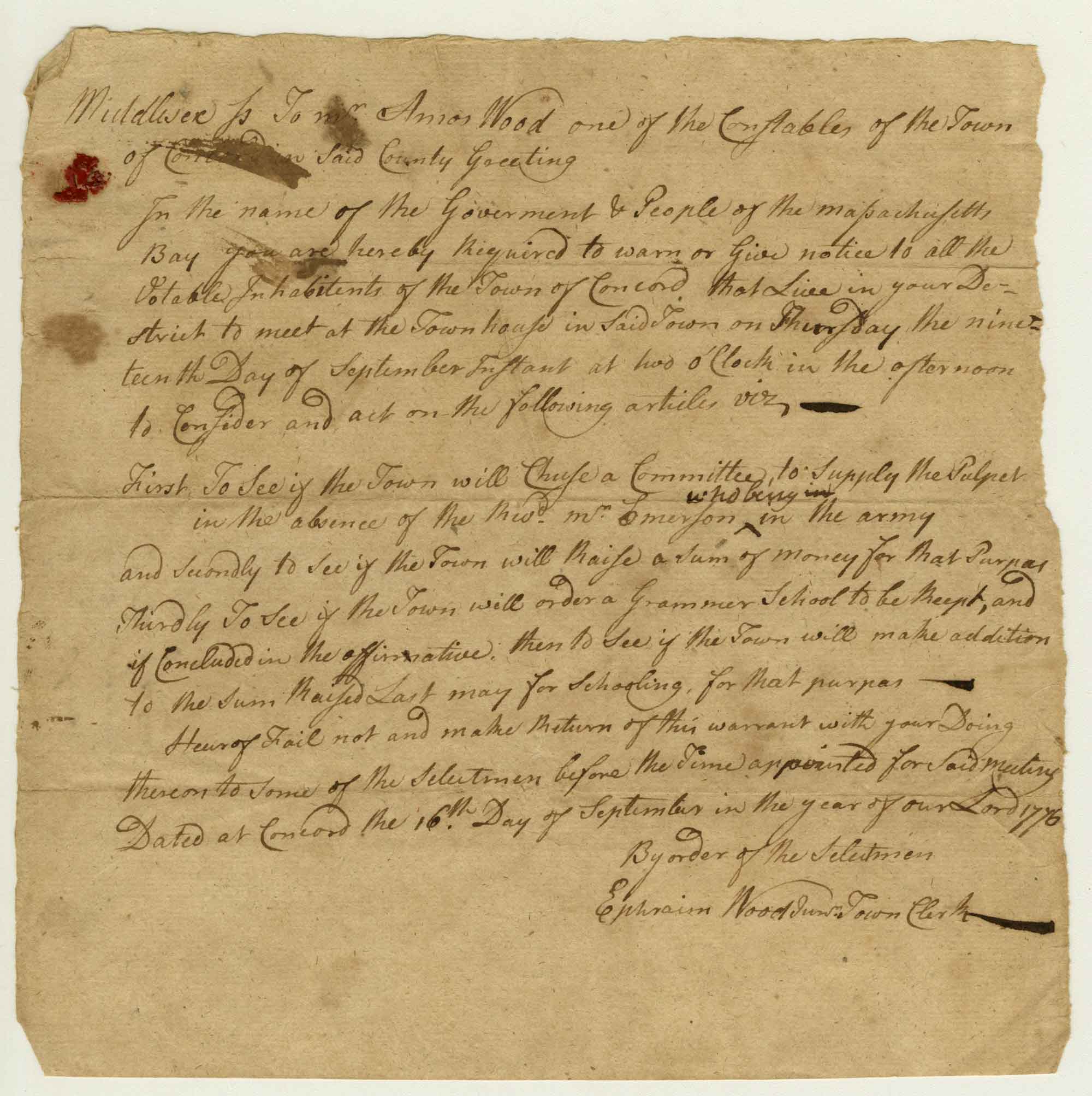
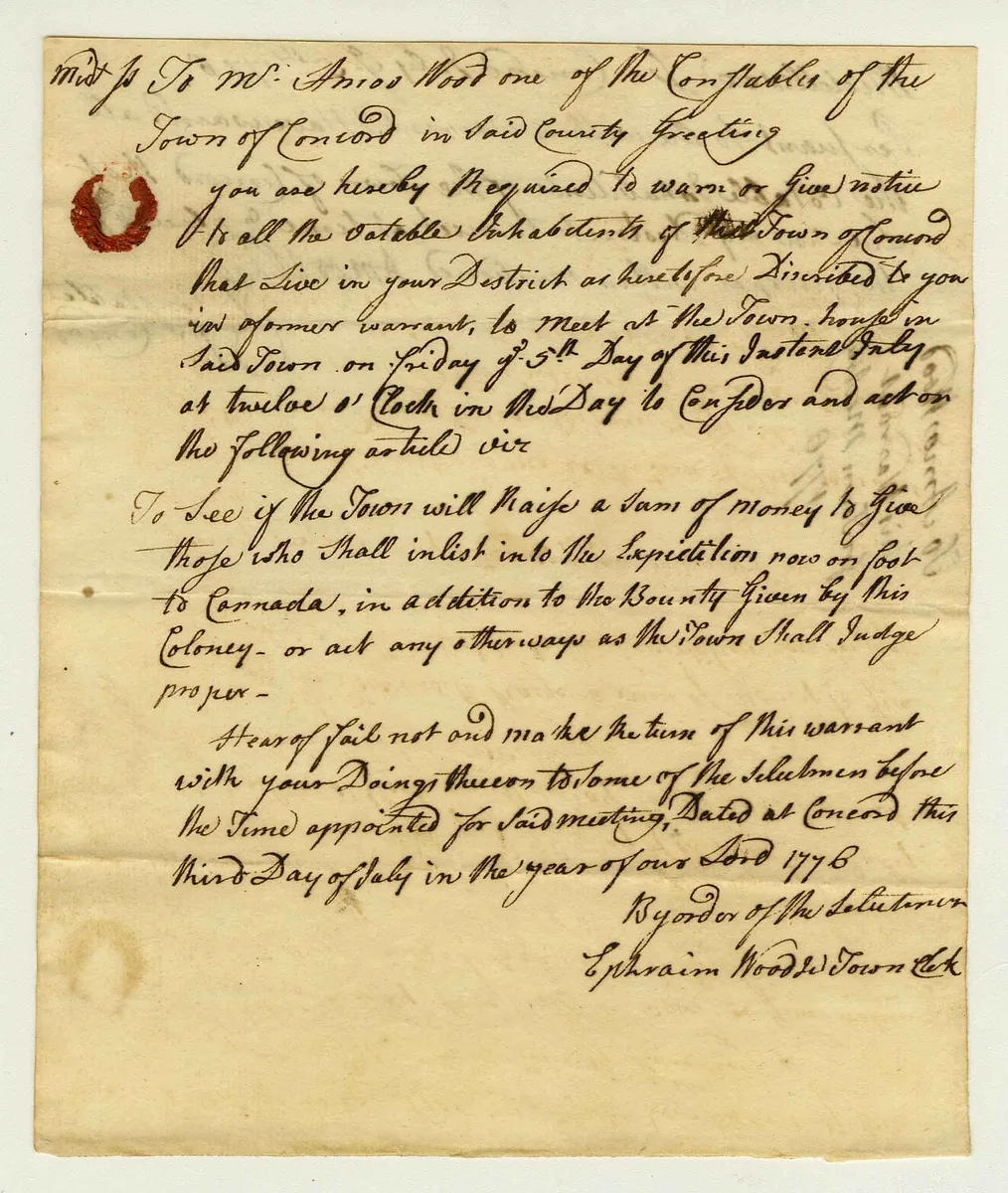
In March 1776, eleven months after April 19, 1775, Concord was still calling town meetings in “his Majesties name,” even as its inhabitants were at war with his troops. By June, the town was supposed to invoke the “Government and People of Massachusetts Bay in New England” as authority for commissions and writs. It failed to comply with this requirement. In effect, the town met on its own accord. Starting in mid-September, the writs for town meeting followed the formula mandated by the General Court.
| All images courtesy of the Town of Concord Archives, Early Town Records Collection
The next step was to mobilize public opinion in favor of national independence. If the Continental Congress issued a declaration, would the freemen of the Bay colony pledge their “lives and fortunes” in its support? On May 10 the Massachusetts House put this question to its constituents, who were about to elect new delegates to the assembly. Through instructions to these representatives, the voters participated in an extraordinary referendum that made the change of regime personal and brought it into every household.
Canvassing the towns slowed the momentum for independence. A month into the voting, a third to a half of all towns had not yet submitted a return. The legislature had to try again to improve the response. The process dragged out so long that the Massachusetts legislature did not endorse a Congressional declaration of independence until July 3, too late to have any bearing on the outcome. The frontline state was now near the rear of the pack.
The Massachusetts referendum nonetheless revealed the spectrum of opinion, as much by what the freemen didn’t say as by what they did. The simplest response was to instruct the town’s representative in the assembly to go along with whatever the Continental Congress deemed best for their “interest” or their “safety.” That was the course taken by Weston, a latecomer to the Patriot ranks. Others were more positive in endorsing independence: Sudbury emphasized its “hearty and sincere” commitment to the cause; Topsfield gave its “strongest assurance.” Some communities rehearsed their grievances against Britain and asserted their political principles. Groton saw a choice between “a state of abject slavery” and total separation from a King and Parliament, whose “wicked Councils” had caused the crisis. Acton cited the “many Injuries and unheard Barbarities” the colonies had endured as justification for rejecting royal rule. “An American Republick . . . is the only form of Government we wish to see Established.”
Independence was not a universal choice. Nantucket remained neutral during the war. In spring 1776 Barnstable, a Loyalist stronghold on Cape Cod, said no. Other towns, notably Concord, remained silent. Despite its key role in starting the war, the town took no leadership in declaring independence. Its clerk, Ephraim Wood, eliminated reference to the Crown in warrants for town meetings after May 1776 but waited until September to invoke the authority of “the Government and People of Massachusetts Bay.” Concord likewise avoided the issue of independence when it chose Joseph Hosmer and John Cuming to be its representatives in Boston. Instead of instructing them on how to vote, the town said nothing, in sharp contrast to nearly all its neighbors.
Whatever the enthusiasm for independence (or lack thereof), Massachusetts welcomed notice of the declaration. It took ten days for an official printed copy to travel from Philadelphia to Boston, twice as long as reports of the fighting on April 19 had gone in the opposite direction. The news arrived on July 18 in a capital under quarantine from smallpox, but that didn’t dampen the celebration. From the balcony of the State House, Col. Thomas Crafts, Jr., commander of the Massachusetts Train of Artillery, read the Declaration aloud to a pop-up crowd on King Street, who listened with “great attention” and erupted in three cheers at his closing words, “God Save our American States.” A crescendo of sound filled the air, with bells ringing, muskets firing, and cannon roaring. James Bowdoin, president of the Massachusetts Council, closed the ceremony with a hope for “Stability and perpetuity to American independence.” Later that day the king’s arms were removed from the State House and cast into a bonfire with other insignia of the Crown. “Thus ends royall Authority in this State,” Abigail Adams observed, “and all the people shall say Amen.”
Similar ceremonies were held elsewhere in the Bay State. Four days after Boston, “patriotic gentlemen” in Worcester gathered near the liberty pole on the green for a public reading, followed by the same demonstrations of joy—“bells a ringing, drums a beating,” cannons blasting, bonfires burning, and toasts and drinks aplenty. Newburyport held a similar celebration a few weeks later. The Fourth of July was already taking on its familiar form.
The Massachusetts Council quickly confirmed the Declaration of Independence as the law of the land. It sent copies to the ministers of every church and denomination in the state, with instructions to read it aloud from the pulpit at the close of Sunday worship. The clerks of each town were directed to inscribe the Declaration in the official record book “as a perpetual memorial.”
Presumably, most clergy and clerks complied, but Concord took its time. Its pastor, William Emerson, was a fiery champion of the American cause. Every Sabbath he conscientiously recorded in his diary when and where he preached. He was in Concord’s pulpit on the eligible days of worship, but not a word about the Declaration appears in his journal. For that matter, town clerk Ephraim Wood did not copy the manifesto of independence into the town record book until October, around the same time he began complying with the law in warrants for town meetings.
Then again he was ahead of Acton, which entered the declaration into its official proceedings in March 1777, eight months after the event. In declaring independence, John Adams later mused, “thirteen clocks were made to strike together.” Thereafter the citizens of the new republic followed their own preindustrial pace.
NOTE: 1. ”An Act For Establishing The Stile Of Commissions Which Shall Hereafter Be Issued, And For Altering The Stile Of Writs, Processes, And All Law Proceedings, Within This Colony; And For Directing How Recognizances To The Use Of This Government, Shall, For The Future, Be Taken And Prosecuted,” Acts and Resolves of Massachusetts, 1775–76, Chapter 22; Henry B. Dawson, Declaration of Independence by the Colony of Massachusetts Bay: May 1, 1776 (1862). On May 4, 1776, three days after Massachusetts, the Rhode Island Assembly passed its own “Act of Renunciation” changing the language of writs, commissions, and oaths.