Henry David Thoreau’s younger sister, Sophia Elizabeth Thoreau (1819–1876), was a botanist, artist, editor, and abolitionist who worked as a teacher and managed the family’s pencil business. She significantly shaped her brother’s legacy to an extent that modern scholars argue was under-acknowledged by Thoreau’s early biographers.
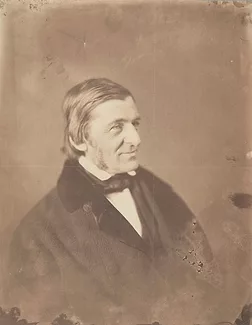
Ralph Waldo Emerson lived in Concord for most of his life and probably explored almost every inch of it on foot. As he once said, “I go through Concord as through a park.” Today, we can follow in the footsteps of the “Sage of Concord.”
Although Concord’s Henry David Thoreau (1817-1862), naturalist and transcendentalist, is now a widely read American author, he did not support himself through his writing. In the 1840s, Thoreau became proficient as a land and property surveyor, an occupation that had no licensing requirements at the time and allowed him to spend much time “sauntering” outdoors.
The Thoreau Society was founded in 1941 to stimulate interest in and foster education about Thoreau’s life, works, and legacy and his place in his world and ours; to encourage research on Thoreau’s life and writings; to act as a repository for Thoreauviana and material relevant to Thoreau; and to advocate for the preservation of Thoreau Country.
Henry David Thoreau loved springtime. While it’s true that he had something to say about every season, he seemed to wax more poetic not only in the spring but about the spring. When the earth came alive after a long cold winter, Thoreau’s observations came to life as well.
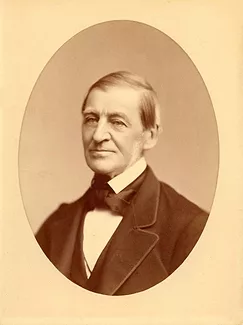
Have you found yourself wandering around Concord and wondering exactly how Ralph Waldo Emerson (1803-1882) is connected to the central story of the town? The philosopher’s name is everywhere, his name connected to every story somehow.
“Why Concord?” asks historian Robert A. Gross in the preface to his new book, The Transcendentalists and Their World (Farrar, Straus and Giroux, 2021). One drizzly October afternoon I asked him the same question about his own choice to devote much of his career to examining this singular dot on the map of New England.
“I came to study Concord not because I was interested in the local history,” he said. “I was interested in the local history as it helped to tell a national history. And I’ve come to love living here. I love the fact that I’m telling a large story with broad implications in one place, a place that is not a backwater, not on the margins.”
In the early spring of 1862, as the first buds began to appear, two men made their way along Main Street. Concord knew this pair well; over the last twenty years, these “knights of the umbrella and bundle”1 had rambled together from the Walden Woods to Montreal, from Cape Cod to the Catskills.
Henry Thoreau had been the more vigorous of the two, but today the poet Ellery Channing offered Henry an arm to lean on as he paused to catch his breath. His tuberculosis was growing worse, and his faithful friend Ellery had come to walk this familiar path with him for what might be the last time.
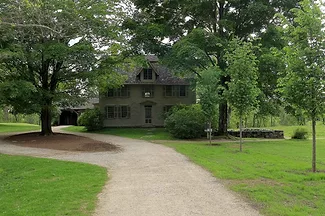
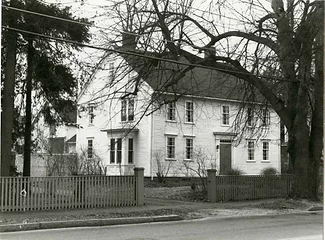
The Marquis de Lafayette visited Portland, Maine during a grand tour of the United States in 1825. When Mary Moody Emerson—fifty years old at the time—was introduced to the aging hero of the American Revolution, she told him she was “‘in arms’ at the Concord Fight.”1
It was a joke, but as always, her wit had an edge of truth. She was indeed present for the “shot heard ’round the world,” but the “arms” she was in were her those of her mother, clutching eight-month-old Mary as the battle raged 150 yards from her window at the Old Manse.
Ralph Waldo Emerson was not the originator of the romantic ideals known as Transcendentalism. Nor was his premier essay, Nature (1836), the first publication to set forth the philosophy. Emerson was, rather, the most successful public voice of New England Transcendentalism in the nineteenth century. Dissatisfied with his traditional ministry, Emerson embarked on an untried profession as a lecturer, essayist, and poet; gaining an international reputation. His eloquent and provocative prose resonated with a young American republic yearning to define itself against the time-honored past. Emerson turned his personal search for meaning into a national paean for a self-actualized identity. Nature was closely followed by his controversial “American Scholar,” “Divinity School Address,” and iconic “Self-Reliance.”
.webp?height=325&t=1723651553&width=325 "Thoreau_Sophia_GRAY22AS-(2).jpg")

_300dpi.webp?height=325&t=1725080360&width=325 "HD_Thoreau_(Maxham)_300dpi.jpg")

.webp?height=325&t=1727737362&width=325 "PastedGraphic-4-(3).jpg")