
Transcendentalist and feminist writer Margaret Fuller—Emerson’s friend and collaborator, Bronson Alcott’s colleague, Thoreau’s first editor, and Ellery Channing’s sister-in-law—was central to Concord’s literary and intellectual life. She first came to Concord in the summer of 1836, when she met Emerson and stayed with his family for three weeks.
Through the mid-1840s, Fuller made several long visits, staying at the Emerson house, with the Hawthornes at the Old Manse, and with her sister Ellen Channing. She spent time walking by Concord’s rivers, to Walden Pond, and in Sleepy Hollow. Her visits profoundly affected her. “What is done here at home in my heart is my religion,” she noted in her Concord journal in 1842.1
In Concord, Fuller found solace, inspiration, communion, and deeper self-knowledge during the years that transformed her from a teacher into a leading conversationalist in women’s intellectual discourse, the Dial’s first editor, and the first female literary critic and foreign/war correspondent for the New-York Tribune. She wrote significant parts of Women in the Nineteenth Century—considered the first major feminist work in the United States—in Concord.
Fuller once described Concord as “the ideal, the true community,” offering spiritual belonging.2 She never settled here, as Emerson urged, but she might have, had she survived her return voyage from Europe.
In 2010, the Transcendentalist Council of First Parish and historic sites in town celebrated Fuller’s bicentennial. She was sought by Concord’s modern-day visitors; a footnote on tours. Still, there was no dedicated place to honor Fuller in Concord’s landscape—until now.
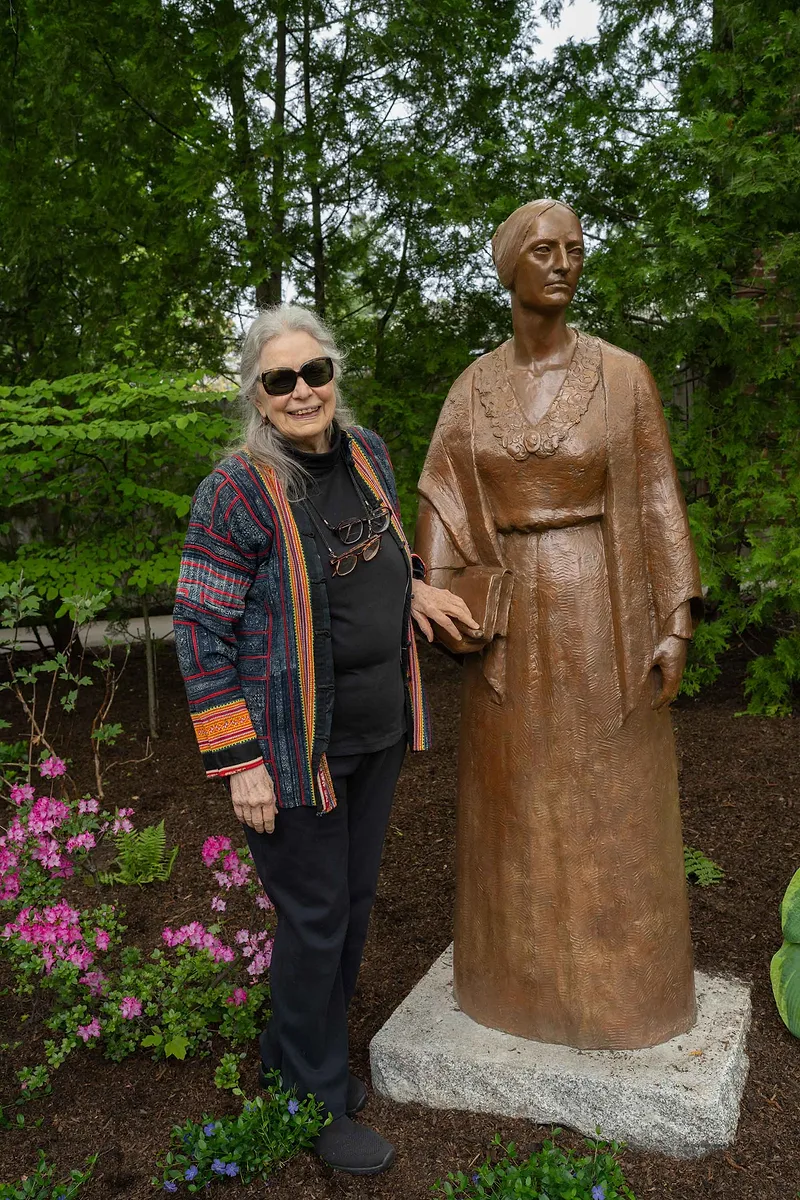
On May 23, 2026—Fuller’s 216th birthday—celebrants gathered at the Concord Free Public Library to unveil Penelope Jencks’ 1985 life-size bronze sculpture of Fuller, donated by Ronald Lee Fleming, a preservationist and public arts advocate who commissioned the work. Originally intended for installation in Harvard Square’s subway station to honor Fuller as the first woman admitted to Harvard’s library as a reader, Jencks’ Fuller instead spent decades in Fleming’s garden. Following restoration by Skylight Studios in Woburn (funded by the Library Corporation’s Munroe Society), Margaret Fuller now has a publicly accessible home in the library’s Garden Retreat on Sudbury Road. Accompanied by new periwinkle plantings and surrounded by flowering shrubs, the sculpture stands in a fitting setting, surrounded by blossoming nature, books, and art; suited for contemplation and inspiration.
With Fuller family descendants in attendance, Library Corporation Trustees President Sherry Litwack, Special Collections curator Anke Voss, Fleming, Jencks, and Fuller’s Pulitzer Prize-winning biographer Megan Marshall spoke prior to Jencks’ unveiling of her sculpture and a reception in the garden. Jencks included a subtle nod to Fuller’s grandnephew Buckminster Fuller in her work: a tiny cameo portrait. Fleming’s remarks emphasized the importance of public art, while Voss and Marshall recalled Fuller as a woman of “firsts” in her prestigious literary and journalistic career and trailblazing life, and a fitting subject for Concord’s first outdoor public sculpture depicting a woman. Marshall reflected further on the “rightness” of the subject—a resonant voice for our times; the moment; the place, with Concord’s significance to Fuller’s life and career; and the work, capturing Fuller’s dignity, intelligence, and personal courage.
With the sculpture’s installation at the Concord Free Public Library, Fuller is again at home in Concord’s heart.
NOTES: 1. “Margaret Fuller’s 1842 Journal: At Concord with the Emersons,” ed. Joel Myerson, Harvard Library Bulletin (July 1979): 336. 2. Ibid.
