Discover Concord Logo
Toggle Mobile MenuToggle Mobile Menu
Subscribe
  • Home
  • Current Issue
  • Back Issues
    • Fall 2025
    • Spring 2025
    • Winter 2025
    • 2024 Back Issues
    • 2023 Back Issues
    • 2022 Back Issues
    • 2021 Back Issues
    • 2020 Back Issues
    • 2019 Back Issues
  • Browse Topics
    • Abolitionism in Concord
    • American Revolution
    • Arts & Culture
    • Celebrity Profiles
    • Civil War
    • Concord History
    • Concord Writers
    • First Nations People of Concord
    • Historic Sites in Concord
    • Parks & Nature
    • Patriots of Color
    • Things to See & Do
    • Transcendentalism
    • Trivia
    • Untold Stories of Concord
  • Plan Your Visit
  • Events
  • Purchase Subscriptions and Back Issues
  • Discover the Battle Road
  • 250 Collectibles
  • Trading Cards
  • More
    • About Us
    • Advertise
    • Contact Us
Toggle Mobile MenuToggle Mobile Menu
Home » Publications » Discover Concord

Our Publications

Please select a publication below.

Discover Concord
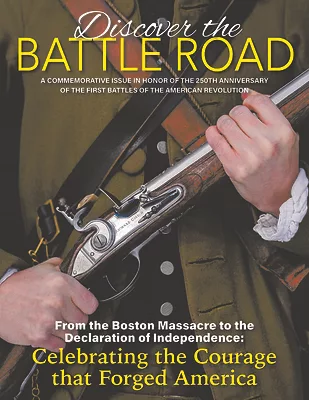
COVERDiscoverBattleRoad NPS image no logo.jpg

Discover the Battle Road

This Week's New Content

Volume: 1
Edition: 1

As part of the America250 celebrations, new content from the commemorative publication, Discover the Battle Road, will appear here twice weekly. The latest update features: "Colonel Barrett's Hustle" and "The Battle of Menotomy".

To order a copy of the full printed edition, click on Discover the Battle Road or 250 Collectibles in the menu above.

  • Content in this issue

Content in this issue

Back to Top
colonial-soldier-picture-id173798978.jpg

Colonel Barrett’s Hustle

March 28, 2025
Jaimee Joroff
No Comments

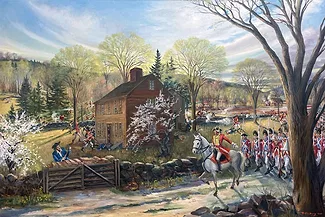
Have you ever tried to quickly clean up the house before last minute guests come over? Heart pounding down the seconds until their obnoxiously presumptuous fists knock on the door, you do a little frantic shoving, maybe commit a little bit of treason, and hope the house looks presentable. 


Read More
orig_518209_7947.jpg

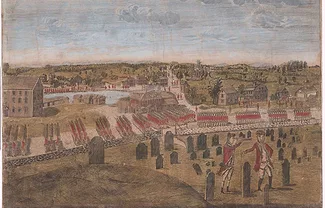
The Battle of Menotomy

March 28, 2025
Michael Ruderman
No Comments

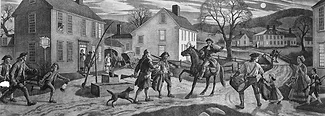
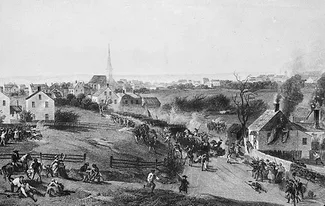
In 1775, Menotomy was a village of about 400 farmers, millers, tavern keepers, and their families. Located in today’s Town of Arlington, Menotomy stretched along Massachusetts Avenue from “the foot of the rocks” near Lexington to Alewife Brook. On April 19, 1775, the Battle of Menotomy would be the largest, longest, and bloodiest engagement of the day.


Read More
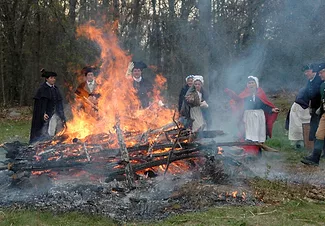
Am-Rev-era-soldier-istock.com-Heather-McGrath.jpg

Restoring Their Legacy: Rediscovering Concord’s Fallen from the Revolutionary War

March 28, 2025
Beth van Duzer
No Comments

Americans have a deep reverence for those who perished in military service. Communities remember those who died during their service by providing free military gravestones, placing flags on graves, and erecting monuments or memorials. The soldiers who died during the Revolutionary War were America’s first veterans. Here in Concord, there has been a long-standing tradition each Memorial Day of reading the names of those who died in service. Until 2023, only one name was read for the Revolutionary War: Reverend William Emerson. For as long as anyone could remember, he was the only person remembered by the town for dying during his service in the Revolutionary War.


Read More
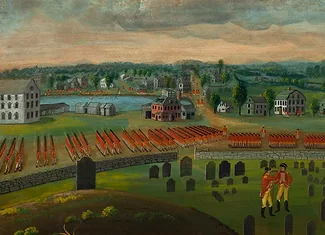
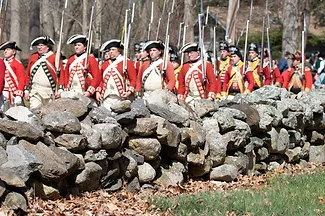
British-soliders-marching-behind-wall.jpg

Secrets, Stones, and Soldiers on the Battle Road

March 28, 2025
Jaimee Joroff
No Comments

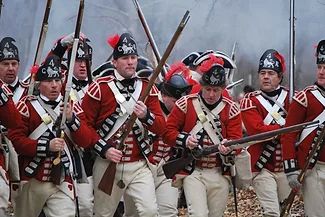
On the morning of April 19, 1775, over 700 King’s troops marched into Concord to search for military supplies that spies had told Royal Governor Gage were being hidden there to support a rebellion against the King. Their search met unexpected resistance, exploding into a day-long battle over eighteen miles from Concord to Boston with fighting on open ground and from behind trees and stone walls. Today, you can retrace the soldiers’ steps along the Battle Road and imagine the landscape and walls as they were that day thanks, in part, to a 2024 project by Minute Man National Historical Park to rebuild the park’s historic stone walls in Concord, Lincoln, and Lexington. Led by Michael Papile, a team of professional stone wallers affiliated with The Stone Trust (an organization dedicated to preserving and advancing the art of dry stone walling) restored these walls. Stone by stone, stories of time were put back together.


Read More
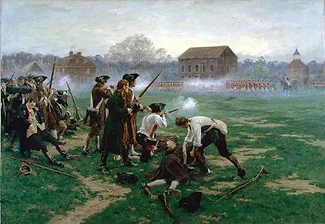
The_Battle_of_Lexington-wikimedia.jpg

Prince Estabrook: From Lexington Green to the Hudson River Valley

March 28, 2025
Robert A. Bellinger
No Comments

Early on the morning of April 19, 1775, approximately 70 men, all residents of Lexington, Massachusetts, gathered on the Town Green in response to the news that the British Regulars were approaching the town on their way to Concord to search for stores of ammunition. The Lexington men were members of the local militia responsible for protecting their community. Among those Lexingtonians was Prince Estabrook, a man of African descent who was enslaved by Benjamin Estabrook, another Lexingtonian. Whether or not Prince, or any of the other men, were aware of how the events of the morning would play out, it is certain that he did not envision that he was laying the foundation for a new nation. Even so, Prince embodied the events and issues of the day in a way that was distinct from the other men who gathered on the Green that April morning.


Read More
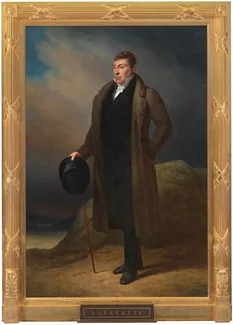
Portrait-of-Lafayette.jpg

Lafayette: A Bridge between Two Revolutions

March 28, 2025
Julien Icher
No Comments

Concord, Massachusetts, is home to two important revolutions: a military one starting on April 19, 1775, and a moral, intellectual, and ideological one, epitomized more than half a century later by the Transcendentalist movement and its staunch support for the abolition of those enslaved in America. Few heroes in American history resonate so strongly with both of these movements as the iconic Frenchman, the Marquis de Lafayette.


Read More
4th-Regiment-of-Foot-Light-Infantry-Company.jpg

Who Won the Battles of Lexington and Concord?

March 28, 2025
Jim Hollister
No Comments

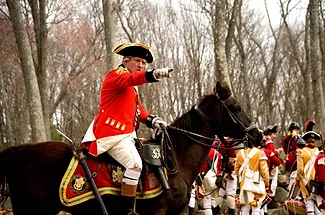
In war, there are many ways to define victory. So, who won the Battles of Lexington and Concord? On the surface this may seem simple. The colonists were able to keep most of their military supplies safely out of British hands. The British soldiers then suffered heavy casualties during their retreat to Boston where they were trapped and besieged. However, though things certainly did not go the way they wanted, did the British Army actually lose on April 19, 1775? The answer depends upon how you define victory.


Read More
Prudence-Wright-memorial-stone-DAR.jpg

Prudence Cummings Wright: Leading the “Minutewomen” of Pepperell

March 28, 2025
Beth Anderson
No Comments

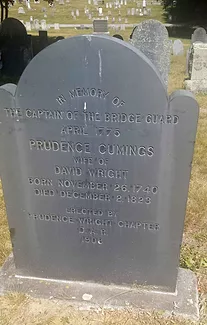
Prudence Cummings, born in 1740 in Hollis, New Hampshire, did chores, learned household skills, and played much like any other colonial girl. But unlike many, she attended school, hunted and fished with her father, and participated in family discussions about the future of the colonies. By the time she married David Wright and moved to Pepperell, Massachusetts, colonial resistance to British rule had increased. Soon, Prudence led the women of Pepperell to burn tea on the town common and boycott English goods. When the townspeople raised a liberty flag, Prudence joined in, boldly defying the king.


Read More
King_George_III_and_Queen_Charlotte_with_their_six_eldes.jpg

His Majesty King George III: From “Our Common Father” to a Tyrant

March 28, 2025
Richard Smith
No Comments

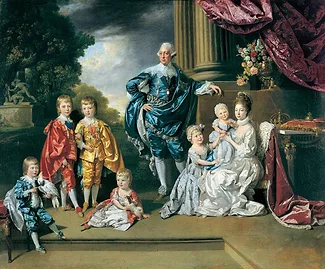
With the death of King George II on October 25, 1760, his 22-year-old grandson George III became the King of Great Britain and Ireland. Reports of the ascension of the new monarch reached the American colonies in early January 1761, and the first colonists to hear the news were the people of Massachusetts. The rise of the man who would become the last king of America was met with great fanfare and joy. 


Read More
iStock-458135085.jpg

The Loyalist Guides of Lexington and Concord

March 28, 2025
Alexander Cain
No Comments

In 1774 when Parliament passed the Boston Port Act in an attempt to break the Massachusetts colonists of their resistance to Crown policy, it also authorized English General and acting Massachusetts Governor Thomas Gage to undertake any military measures necessary to help bring the colony under control. In late winter and early spring of 1775, Gage received a series of dispatches from London ordering him to not only arrest the leaders of Massachusetts’ opposition party but to launch a major strike against the apparently growing provincial stockpiles of weapons and munitions located throughout eastern Massachusetts. As he contemplated these orders, Gage considered a variety of military options, including a long-range strike against the large store of weapons located in the shire town of Worcester, forty miles west of Boston.


Read More
iStock-Nastasic-REPLACE-for-Sons-of-Liberty-Hero-Image.jpg

By The Law of Nature Free Born: The Sons of Liberty

March 28, 2025
Richard Smith
No Comments

The Sons of Liberty was not just a Boston organization. The colonies of New York, New Hampshire, New Jersey, Maryland, South Carolina, and Virginia all had Patriot groups calling themselves the Sons of Liberty. In the years leading up to the American Revolution all the groups were in contact with each other, and all were united to rally public support for colonial resistance against the Crown. 


Read More
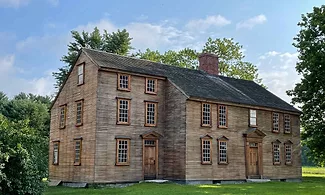
mima_colonel-james-barrett-house_freedomswaynha.jpg

Living History: The Witness Houses of the Battle Road Trail

March 28, 2025
Cynthia L. Baudendistel
No Comments

Standing along the storied Battle Road lie the “witness houses” of April 19, 1775, homes that stood as silent observers to the opening shots of the American Revolution. These homes tell the stories of ordinary people who played extraordinary roles in shaping history.  

Each house represents a unique perspective on the day the colonies rose in defiance of British rule. From the Colonel James Barrett House, where hidden munitions were successfully relocated just days – and even hours - before the arrival of British troops, to the Major John Buttrick House, home of the man who issued the historic command, “Fire, fellow soldiers! For God’s sake fire!,” these homes echo with tales of resourcefulness and bravery.  


Read More
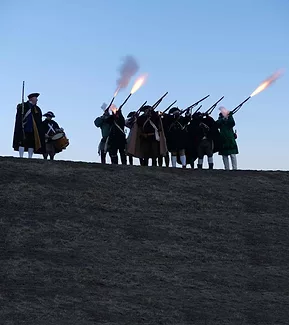
The-Acton-Minutemen-fore-a-volley-from-the-hill-at-NARA-Park-Winter-Carnival-2017.jpg

“I Haven’t a Man Who is Afraid to Go” The Acton Minutemen on April 19, 1775

March 28, 2025
Steve Crosby
No Comments

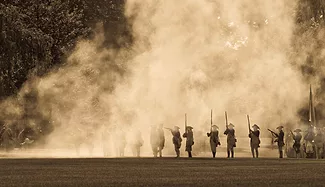
The Acton Minutemen were formed at the end of 1774 at a town meeting. Tensions with England had grown to a boil, and towns everywhere were responding by training their men to fight. The town of Acton, which had previously been part of Concord, chose their best men from their existing militia units to form the new Minute Company, and those men voted 30-year-old Isaac Davis as their captain.

It was the law of the land that every man between the ages of 16 and 60 was required to serve in his town’s militia. They were not paid and met twice each year to conduct marching and musket drills. By contrast, minute companies were paid and met twice each week to drill and train and were arguably among the best trained soldiers in the area when hostilities broke out in April of 1775.


Read More
DoolittleReplacement.jpg

The Revolution Before the Revolution in Concord

March 28, 2025
Ray Raphael
No Comments

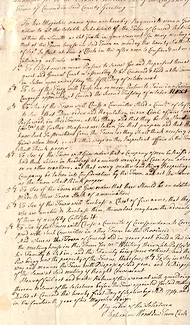
Colonial rebels in Concord did not wait until April 1775 to reject British rule. They did so in October of 1774, a full six months earlier—and a small tax on tea was the least of their complaints.

Earlier that year, as punishment for the Boston Tea Party, Parliament had passed the so-called Coercive Acts. Today, closing the Port of Boston gets all the press, but two different measures actually tipped the scales and led to revolution. 


Read More
Lex-tea-burning-Rick-Beyer.jpg

“An Enemy to This Town:” The Lexington Tea Burning

March 28, 2025
Sarah McDonough
No Comments

John Adams once stated that “the Revolution was in the minds and hearts of the people” long before the start of the Revolutionary War. Years before British soldiers fired on the townspeople in the first battle of the war, Lexington was fighting with economics rather than weapons.


Read More
Pi414-DETAIL-20200001-Concord-Museum-.jpg

A Turning Point at Wright’s Tavern

March 28, 2025
Victor Curran
No Comments

As hostilities grew between Massachusetts and the English government in the 1770s, popular opinion was divided. Concord’s “Patriot preacher,” Rev. William Emerson, spoke out for liberty and served as chaplain for Concord’s minutemen. Meanwhile, his brother-in-law, lawyer Daniel Bliss, remained loyal to the King, and would be forced to flee for his life to Canada when war erupted in 1775.


Read More
Jason-Copes,-The-Colonial-Williamsburg-Foundation..jpg

Radicalized Resistance: The Cascade of Events That Led to April 19, 1775

March 28, 2025
Victor Curran
No Comments

At the end of the Seven Years’ War (called the French and Indian War in America), England emerged as the big winner. It had gained control of eastern North America, from the Atlantic to the Mississippi, and from Labrador to Louisiana. 

This victory, sealed by the Treaty of Paris in 1763, came at a steep price. England’s national debt had swelled by an additional £59 million, equivalent to nearly £15 billion today. And the drain on the Treasury didn’t stop there. England had to deploy thousands of soldiers to keep the French and Spanish out and to keep the Indigenous population under control. 


Read More
IMG_1378.jpg

Militia Companies and the April 19th Alarm

March 28, 2025
Jim Hollister
No Comments

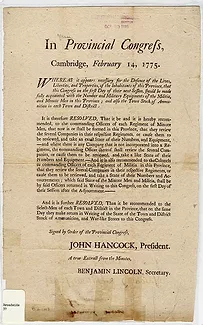
April 19, 1775, marked the first battle of the American Revolution. On that day, 700 British soldiers marched from Boston to Concord to seize a stockpile of military arms and supplies. The expedition caused Patriot leaders to raise the alarm and muster the militia. The scale of the response is truly staggering and hints at a surprising amount of organization. 


Read More

Featured Stories

  • COVERDiscoverBattleRoad NPS image no logo.jpg

    Discover the Battle Road

    This week from Discover the Battle Road:  Meet Colonel James Barrett, who, along with his wife, Rebecca, frantically hid stockpiled arms from British soldiers in the early hours of the morning of April 19, 1775. Later that day, the town of Menotomy (current day Arlington) would experience the largest, longest, and bloodiest engagement of the day. Discover more about the decisive action and selfless sacrifice of that momentous day.
©2026. All Rights Reserved. Content: Voyager Publishing LLC. Design, CMS, Hosting & Web Development: ePublishing
Facebook Instagram